
Smart Glass Products
Make ordinary glass extraordinary

Smart Glass
Smart Film
Smart Glass Doors
Dyed Black Film and Glass
Smart Glass Spaces
Buy Samples
Online Calculator
Smart Glass Applications
Discover how smart glass is being used to for privacy, security and smart design.

Smart Glass Information
We love sharing our industry knowledge, ideas and design tips!

Blog
FAQs
Warranty
Projects
Installation Guide
PRICE
Partner with Us


Smart Glass Electrical Requirements: Transformer Sizing, Voltage & Power Planning
Understand smart glass electrical requirements, from transformer sizing and voltage to busbar placement and wiring, so you can plan your project before installation.
A three-panel glass wall might switch from clear to frosted with a single button. Or the design might call for two panels to frost while the third stays clear. Before the glass goes into fabrication, tell your supplier and electrician how large each panel is, which panels should switch together, and where their wires can leave the frame.
How does smart glass get power?
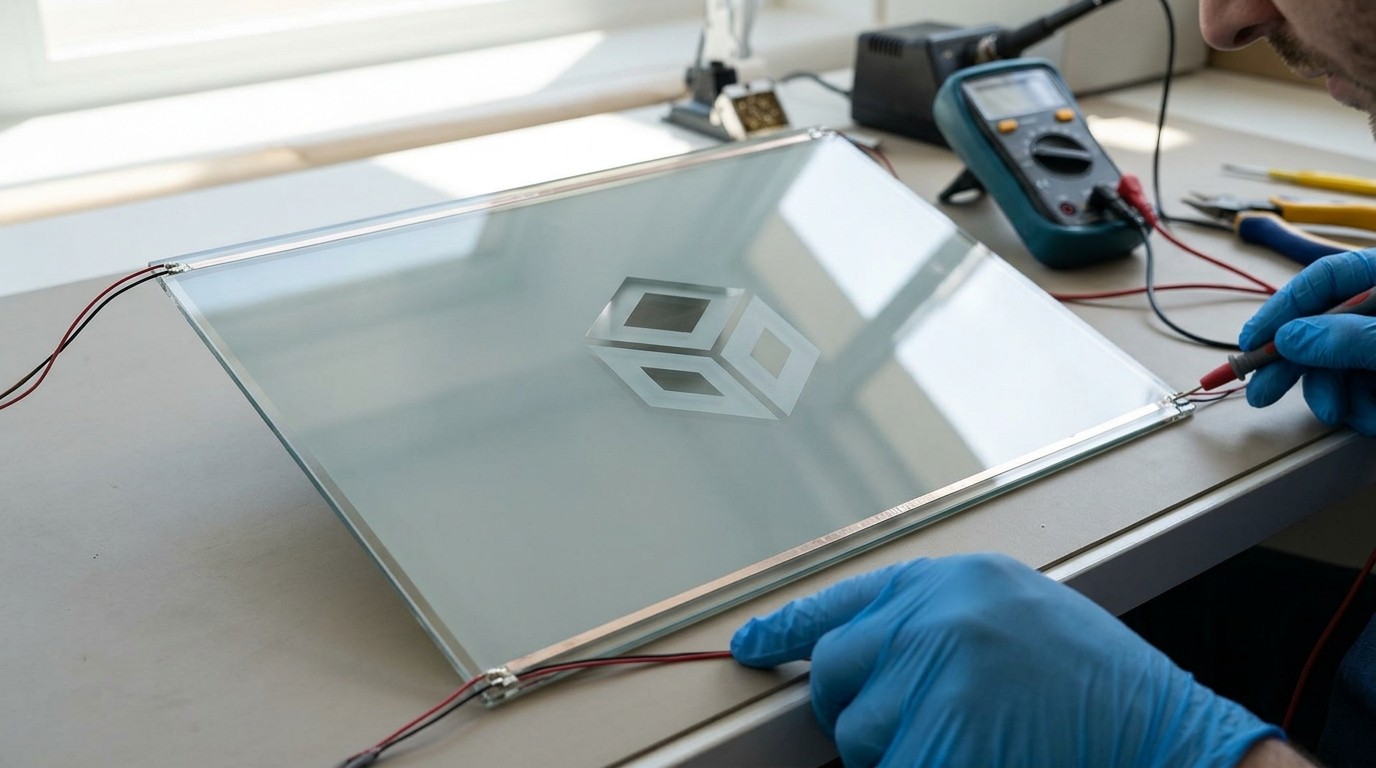
A transformer converts building power to the AC voltage specified for the switchable layer inside the glass. Wires connect the transformer to conductive strips along the panel edge, called busbars. In standard privacy glass, applying power makes the panel clear. Turning it off returns the glass to its frosted state. See how smart glass is powered.
How do you size a smart glass transformer?
Check two specifications. Output voltage must match the panel model you ordered. Capacity determines how much compatible glass the transformer can power. A unit with the right output voltage for one pane can still be too small for a full partition.
Consider a conference room with three panels, each 3 feet wide by 8 feet tall. Each panel has 24 square feet of glass. If they share a transformer, the supplier needs to check the combined 72 square feet against the transformer sizing chart for that product. Give the supplier each panel’s model and dimensions so they can confirm the capacity and number of transformers required.
Which panels should switch together?
Picture a boardroom with a glass front and a side wall facing a hallway. Should a presenter be able to frost just the hallway side? If so, mark each wall as a separate control group on the floor plan. Then decide how occupants will control the glass. A wall switch lets someone set privacy as they enter. A remote lets a presenter change it from the table. Specify adjustable frosting or building automation before ordering so your supplier can confirm compatible controls.
Where should the busbars and wires go?
On a fixed partition, busbar placement determines where the wires leave the glass. Mark the exit edge on the elevation drawing and trace the route through the frame to an accessible transformer location. Have the glazier and electrician review the same drawing while the framing details can still be adjusted.
A moving glass door needs its own wiring detail. On a hinged door, the connection between the fixed frame and the door must accommodate repeated opening and closing. Review the power loop for a swinging glass door with the door hardware team before fabrication.
Optional requirements for switchable logo panels
If a panel includes a custom switchable logo, identify it separately on the panel schedule. Ask the supplier to confirm its transformer requirements and show how power reaches the artwork. Review the visible channels, viewing direction, and appearance in both switching states on the production drawing.
Electrical planning checklist before you order
- Give each panel an ID and record its model, width, and height.
- Mark which panels switch together, how each group is controlled, and where the controls belong.
- Have the supplier confirm the output voltage, combined load, and transformer capacity for each group.
- Mark each busbar edge, wire exit, cable route, and transformer location. Include a wiring detail for every moving door.
- Give the approved panel schedule and wiring drawings to the glazier and electrician before fabrication.
Planning a project? Send Smart Glass Country your panel dimensions and floor plan. Mark which panels you want to switch together so our team can help you select the transformers and controls.


Subscribe to Our Newsletter
Never miss an update. Get all the latest news delivered directly to your inbox.
