
Smart Glass Products
Make ordinary glass extraordinary

Smart Glass
Smart Film
Smart Glass Doors
Dyed Black Film and Glass
Smart Glass Spaces
Buy Samples
Online Calculator
Smart Glass Applications
Discover how smart glass is being used to for privacy, security and smart design.

Smart Glass Information
We love sharing our industry knowledge, ideas and design tips!

Blog
FAQs
Warranty
Projects
Installation Guide
PRICE
Partner with Us


SGC Dimmable Transformer: The Complete Guide to Variable Frost Control for Smart Glass & PDLC Film
Discover how the SGC Dimmable Transformer gives PDLC smart glass and smart film variable frost control instead of simple ON/OFF privacy. Learn sizing, wiring, installation, automation, maintenance, and best practices for reliable, long-lasting performance.
Most smart glass systems offer exactly two states: fully clear or fully frosted. That binary limitation has defined the industry for years — until dimmable transformer technology changed what's possible. The SGC Dimmable Controller/Transformer unlocks variable frost levels, allowing users to dial PDLC smart glass or switchable film to any point along a continuous privacy spectrum. Whether you need a light haze for diffused daylight or dense white opacity for complete privacy, the SGC Dimmable Transformer puts that control in your hands.
In this guide, we cover everything installers, glaziers, architects, and specifiers need to know: how the technology works, the full SGC transformer range, control interface options, wiring rules, concealment strategies, and operational best practices.
📹 Watch our full video walkthrough below.
1. How PDLC Smart Glass Works — The Science Behind the Switch
Before understanding what a dimmable transformer does, it helps to understand what it's powering.
PDLC (Polymer Dispersed Liquid Crystal) smart glass and smart film contain a centrally embedded PDLC layer — a matrix of liquid crystal particles suspended in a polymer film. The behaviour of these crystals determines the glass state:
- Power OFF: Liquid crystals are randomly oriented, scattering incoming light and producing a frosted white appearance — instant privacy with zero power draw.
- Power ON: An electric field causes the crystals to align uniformly, allowing light to pass through cleanly — full transparency.
Standard transformers make this an all-or-nothing switch. Dimmable transformers vary the voltage supplied to the PDLC layer, which partially aligns the crystals and produces intermediate frost states — from light translucency to near-full opacity. PDLC switching is near-instantaneous, occurring in under 0.1 seconds.
PDLC vs. Electrochromic Glass
PDLC dimming controls light diffusion (haze/frost) and operates in milliseconds. Electrochromic (EC) glass, by contrast, uses low DC voltage to gradually tint the glass (clear to dark blue) over seconds or minutes, blocking solar heat gain while preserving view clarity — and only requires power to change state, not to maintain it. They serve different architectural purposes and should not be confused.
2. SGC Transformer Range — Choosing the Right Capacity
SGC H-series transformers accept 110VAC or 220–240VAC mains input and step down to 48V–68V AC output to power PDLC panels. Sizing is based on the total area of glass being powered:
Energy efficiency note: PDLC smart glass and film draw only 0.1A per 10 sq ft and consume 4–5 watts per 10 sq ft in the clear (ON) state. Power consumption in the opaque (OFF) state is zero.
3. The SGC Dimmable Controller — Variable Frost, Three Ways to Control It
The SGC Dimmable Controller/Transformer is available in 50W and 100W models. Both accept 110VAC or 220–240VAC input and output 48V–68V DC to drive PDLC film. The 50W unit measures 165 × 98 × 40mm and weighs 1.2kg — compact enough for concealed installation in millwork, ceiling bulkheads, or service cupboards.
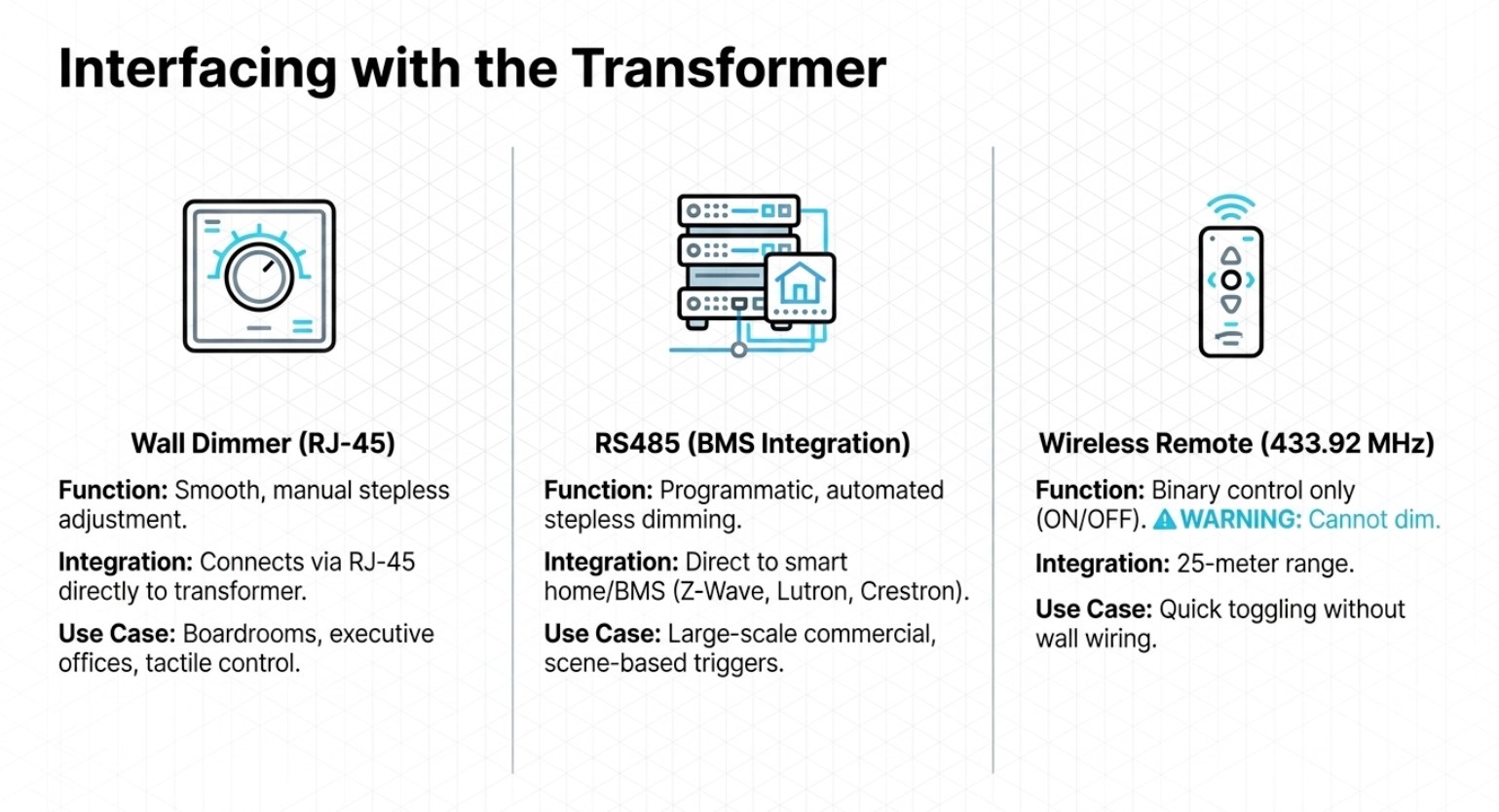
Control Interface 1: Wall Dimmer (RJ-45)
The primary method for adjusting frost levels. The wall dimmer connects to the dimmable controller via RJ-45 cable and provides smooth, stepless adjustment — from full opacity to full transparency. This is the recommended interface for any installation where end users need direct tactile control.
Control Interface 2: RS485 (Smart Home & BMS Integration)
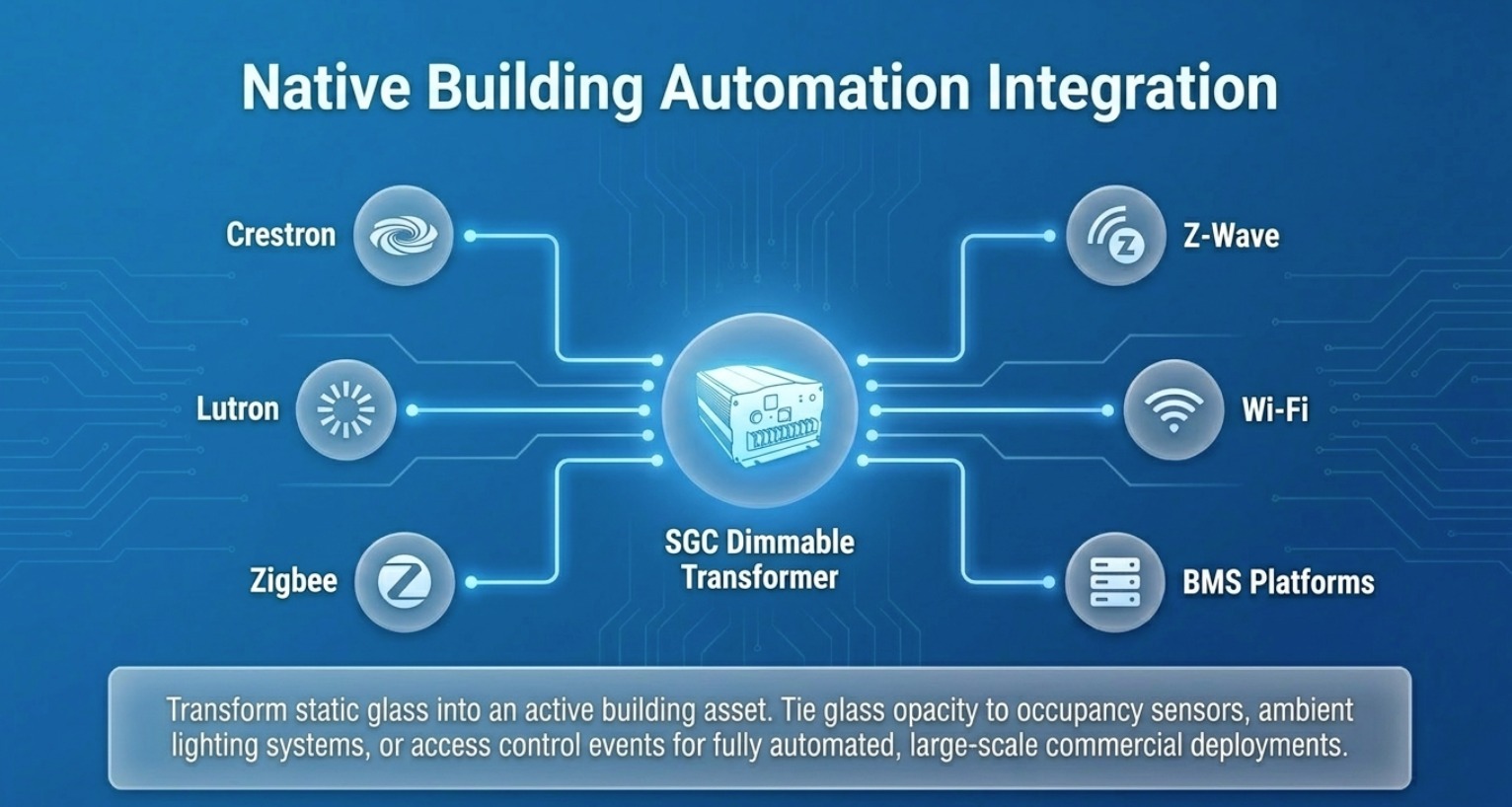
The RS485 port enables integration with smart home platforms and building management systems — including Z-Wave, Zigbee, Wi-Fi, Lutron, and Crestron. This allows automated, scheduled, or scene-based dimming control programmed directly into your building automation workflow.
Control Interface 3: Wireless Remote (433.92 MHz)
The included wireless remote operates at 433.92 MHz with a range of up to 25 metres.
⚠️ Important: The wireless remote supports ON/OFF switching only. Variable frost level adjustment requires the wall dimmer or RS485 interface. This is a common source of installer confusion — the remote cannot dim.
4. Multi-Zone Control — Zoned Privacy From a Single Controller
Standard single-channel transformers power all connected panels as one group. For installations requiring independent zone control within the same room or space, SGC offers multi-channel controllers:
- Up to 6 independent output channels per unit
- Available in 50W and 100W capacities
- Output: 48V or 68V AC per channel
- Individual panel control via multi-button remote
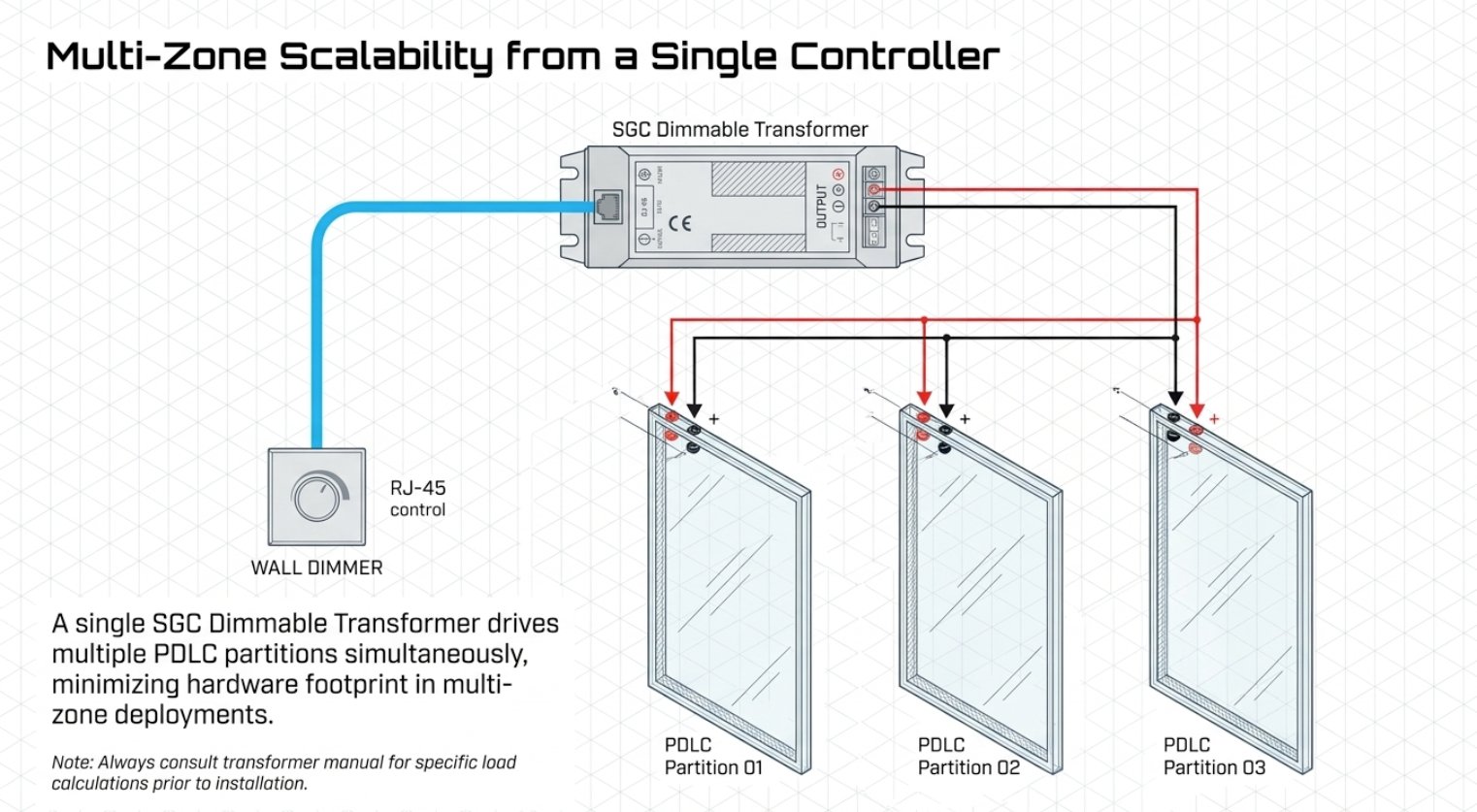
One dimmable controller can also be wired to output power to multiple PDLC partitions simultaneously — making it well suited for open-plan offices, healthcare facilities, and commercial fit-outs. Always refer to the transformer manual for full wiring diagrams.
5. Installation Rules — What Every Electrician Must Know
All electrical wiring must be completed by a licensed electrician. The following protocols are non-negotiable for a safe, warranty-valid installation.
Mains-Side Switching (Critical)
⚠️ Critical Rule: Control switches, smart relays, and remote receivers must be wired on the mains high-voltage side (110V/220V) — before the transformer. Never splice a switch into the low-voltage output line between the transformer and the film. Doing so causes irreversible damage to both the controller and the PDLC film.
Parallel Wiring Only
Multiple smart glass or film panels must always be wired in a parallel circuit. Series wiring is not compatible with PDLC systems.
Colour-Match Wiring
Although PDLC operates on AC and has no polarity, all installers wiring multiple partitions must strictly match wire colours (red to red, black to black) to prevent permanent film damage.
No-Load Voltage Test
Before connecting the smart film or glass panel to the controller terminals, test and confirm the output voltage at no load to ensure it matches the system's requirements.
GFCI Protection & Earthing
Both the isolation transformer and any conductive glass frames must be connected to a Class A GFCI/GFI protected circuit. All metal framing elements must be properly earthed.
Slow-Blow Fusing
Toroidal and auto-wound controllers are susceptible to magnetizing inrush current on energisation. Always use a slow-blow fuse or time-delayed circuit breaker — never substitute a higher-rated fuse than specified on the transformer casing.
100-Foot Wiring Limit
Low-voltage extension wires from the transformer to the farthest glass panel must not exceed 100 feet (approx. 30 metres). Beyond this, voltage drop will impair switching performance.
6. Concealing the Transformer — Retrofit Best Practices
In retrofit projects, transformers must be concealed without compromising heat dissipation, accessibility, or serviceability.
Option 1: Millwork & Cabinetry
The cleanest solution for residential and hospitality installs. House the transformer inside custom cabinetry, built-in joinery, floating media consoles, or TV units. Must include ventilation gaps or grills and a removable service panel.
Option 2: Ceiling Cavity or Bulkhead
Place the transformer in a drop-ceiling cavity or drywall bulkhead, accessible via a designated service hatch. Ideal for commercial fit-outs where aesthetics demand zero-visible hardware.
Option 3: Adjacent Room or Mechanical Space
House the controller in a nearby mechanical room, storage room, or electrical closet and route low-voltage wires to the glass frame. Maximises accessibility for servicing.
⚠️ Environmental Rating: SGC transformers carry an IP21 rating. They must be installed in a dry environment, away from all moisture and water sources. Never install in an airtight or fully sealed cavity — transformers generate heat and require airflow.
7. Operational Best Practices & Maintenance
The 72-Hour Rule
⚠️ Important: Smart glass and PDLC film should not remain in the ON (transparent) state for longer than 72 continuous hours. Exceeding this limit causes permanent chemical damage to the switchable interlayer.
Daily Rest Period
SGC recommends powering smart glass and film OFF for a minimum of 4 hours per day. This allows the liquid crystals to relax and ensures optimal long-term product lifespan.
Cleaning Protocol
- Always power off the film or glass before cleaning.
- Never spray water or liquids directly onto the film or frames.
- Use a soft microfibre cloth dampened with 70% isopropyl alcohol.
- Wipe in straight, even strokes. Ensure the surface is completely dry before restoring power.
8. Moving Glass — Accessories for Operable Windows & Doors
When smart glass or film is installed on sliding or folding doors and windows, specialised power transfer hardware is required to prevent wire tension and failure:
- Coiled Wires: Extends 80cm to 2m. Placed above sliding doors to accommodate movement.
- Retractable Cable (Wire Extension Box): Up to 1.5m or 2.0m. Rated 250V / 1A, IP21, tested lifespan >30,000 operations.
- Power Transfer Loops (Stainless Steel Springs): Available in 7mm (up to 4.5mm cable) or 14mm/13.6mm (up to 9.4mm cable).
- Magnetic Connectors (Tappet Contacts): 2-pin contact pads (ST9121 white / ST9122 black) for turn/tilt or lifting/sliding panels. No sliding access ramp required.
.jpg)
9. Warranty
Every SGC Dimmable Transformer is backed by a 12-month warranty, effective from the date of arrival at the destination.
Ready to specify or install the SGC Dimmable Transformer?
📞 1-800-791-1977🌐 smartglasscountry.com✉️ info@smartglasscountry.com
Good to know for your CMS: the blockquote > callouts (the ⚠️ warning boxes) will render as styled callout blocks in most CMS platforms including WordPress, Webflow, and Squarespace — paste them in as-is and they should format correctly. If your CMS uses a block editor (like Gutenberg), you may want to convert those to a "quote" or "notice" block manually for better visual styling.


Subscribe to Our Newsletter
Never miss an update. Get all the latest news delivered directly to your inbox.
