
Smart Glass Products
Make ordinary glass extraordinary

Smart Glass
Smart Film
Smart Glass Doors
Dyed Black Film and Glass
Smart Glass Spaces
Buy Samples
Online Calculator
Smart Glass Applications
Discover how smart glass is being used to for privacy, security and smart design.

Smart Glass Information
We love sharing our industry knowledge, ideas and design tips!

Blog
FAQs
Warranty
Projects
Installation Guide
PRICE
Partner with Us


Standard Glass vs Low Iron Glass
Ditch the "green bottle" look. Standard glass hides a secret: 0.1% iron that tints your view and blocks light. Discover how low-iron glass achieves 92% transparency, offering crystal-clear views and the perfect high-tech base for on-demand smart glass privacy.

The progression of architectural glazing from a rudimentary environmental shield to a responsive, "intelligent" component of the building envelope represents one of the most significant shifts in contemporary construction. While standard glass has served us for centuries, the emergence of low-iron smart glass is redefining the possibilities of transparency, energy efficiency, and privacy.
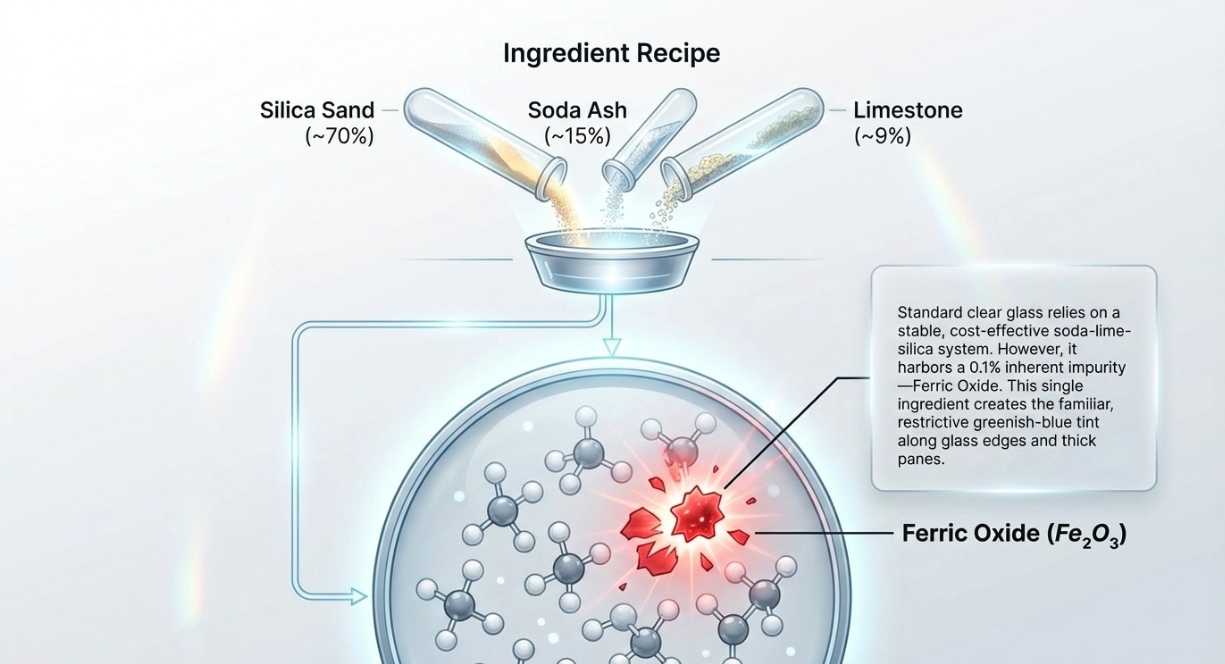
1. The Chemical Foundation: Why Standard Glass is Green
Standard clear glass is a soda-lime-silica system, typically composed of 70% silica sand, 15% soda ash, and 9% limestone. While this mixture is stable and cost-effective, it contains a critical impurity: ferric oxide ($Fe_2O_3$).
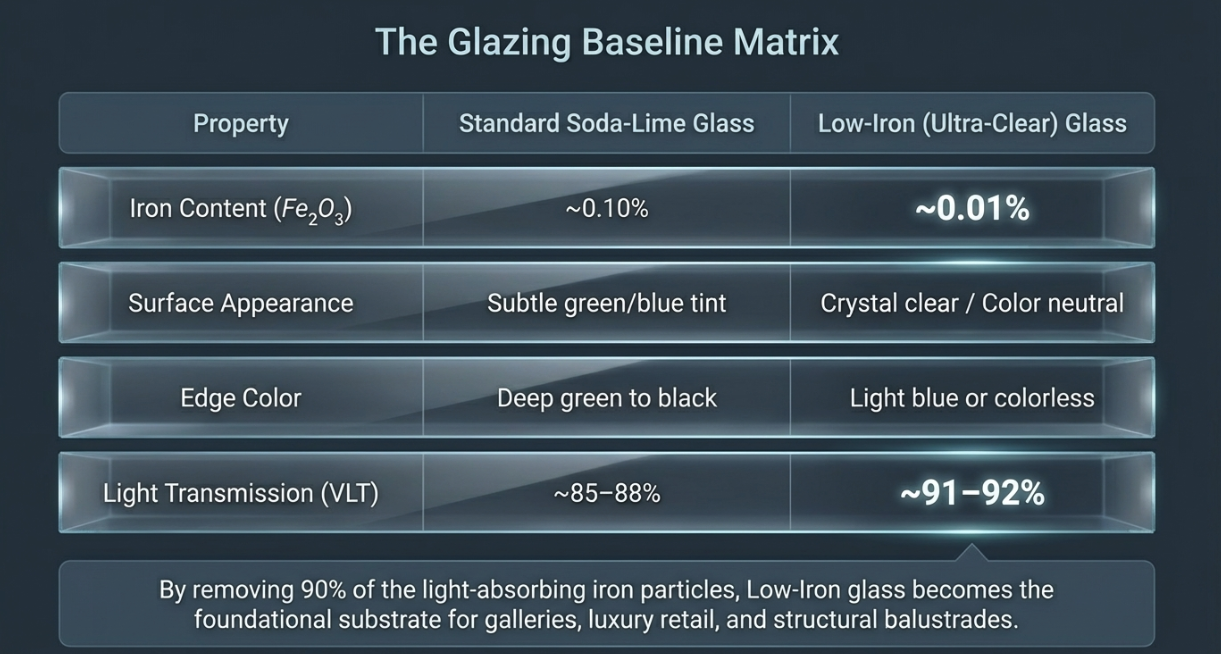
In standard float glass, ferric oxide concentrations hover around 0.1%. These iron ions absorb light in the red and infrared portions of the spectrum, resulting in a characteristic greenish-blue tint. This tint becomes increasingly visible as the glass gets thicker or when viewed from the edge.
The Low-Iron Evolution
Low-iron glass (often called "ultra-clear" or "water-white") reduces ferric oxide content by a factor of ten—down to roughly 0.01%. This chemical purification removes the color cast, providing exceptional neutrality.
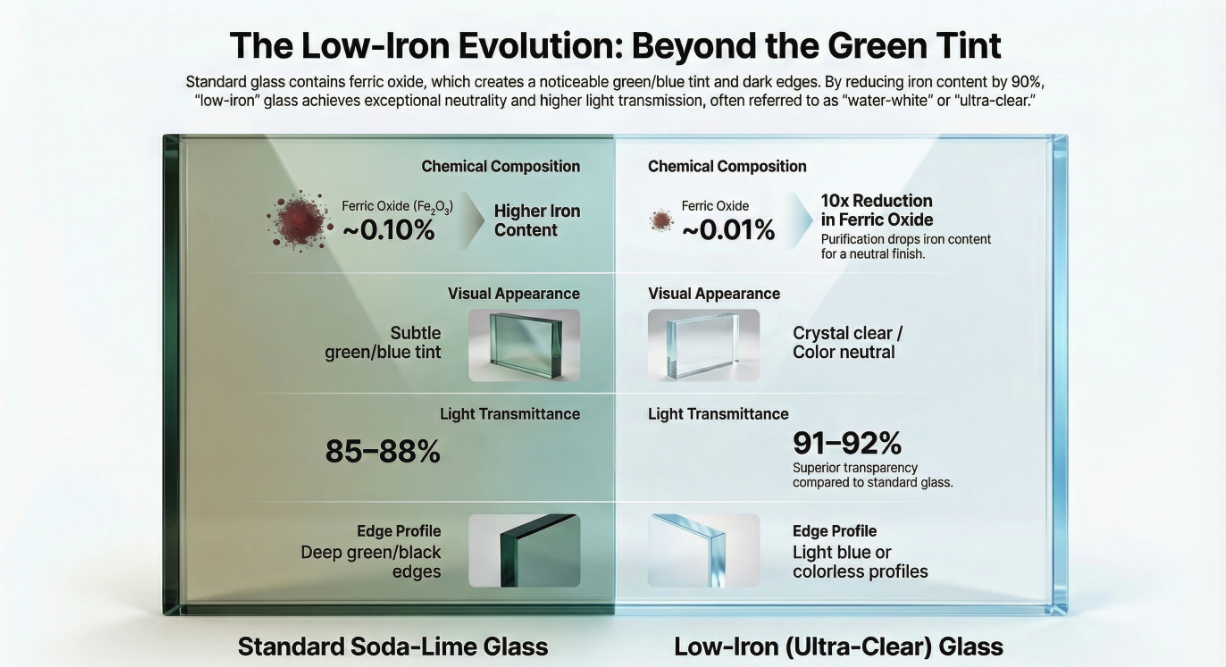
2. Optical Physics and Transparency
The gap between standard and low-iron glass isn't just aesthetic; it’s rooted in spectral absorption. Light is naturally reflected at the interface between glass and air, creating a theoretical maximum transmittance of roughly 92%. Low-iron glass approaches this limit across almost all thicknesses, whereas standard glass performance drops as it thickens.
In high-end retail, art galleries, and structural balustrades, using standard glass at 19 mm thickness makes objects appear dull or green-shifted. Low-iron substrates ensure "true-to-life" color rendering.
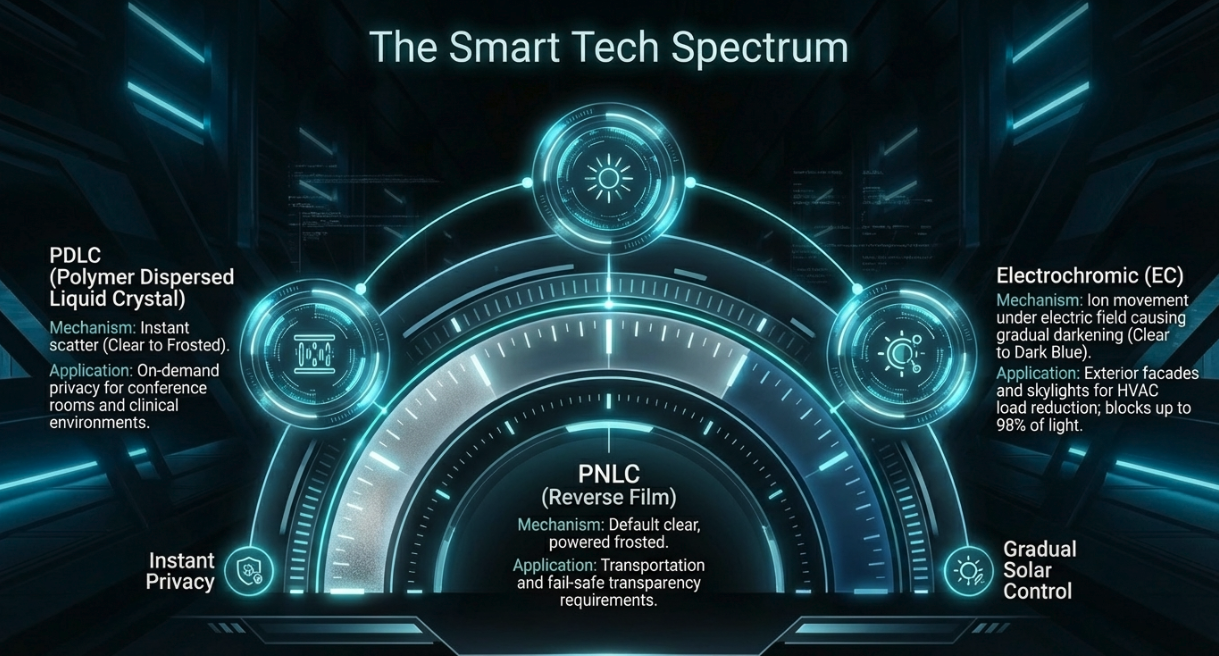
3. Mechanisms of "Smart" Technologies
"Smart glass" refers to dynamic glazing that changes its state via an electrical signal. There are three primary technologies used in modern envelopes:
- PDLC (Polymer Dispersed Liquid Crystal): The standard for on-demand privacy. When "off," liquid crystals are scattered, creating an opaque, frosted appearance. When "on," they align to let light through.
- Electrochromic (EC): Acts like a "dimmer." It gradually tints to manage solar heat and glare, requiring power only during the transition (state memory).
- SPD (Suspended Particle Device): Utilizing rod-like particles that block up to 99.5% of light when unpowered. It offers precise variable tinting, popular in automotive and museum applications.
The Synergy: Why Smart Glass Needs Low-Iron
Applying smart technology to standard glass often results in a "dirty" appearance because the iron’s green tint combines with the inherent haze of the liquid crystals. Low-iron smart glass eliminates this, providing the neutral, high-clarity finish required for minimalist designs.
Financial Modeling
While smart glass is a significant upfront investment, it often pays for itself through HVAC "right-sizing." Because smart glass blocks peak solar heat, developers can specify smaller, less expensive HVAC units.
Case Study: A 5,000-sq.-ft. project using a standard system (with blinds and larger HVAC) cost ~$1.15M, while an integrated smart glass system cost only ~$350k when accounting for the elimination of mechanical shading and reduced energy demands.
Maintenance and Lifecycle
High-quality laminated smart glass has a lifespan of 20 to 30 years. To ensure longevity:
- Electrical Rest: PDLC glass requires a mandatory "off" period of at least 4 hours per 24-hour cycle to maintain crystal elasticity.
- Cleaning: Use only soft cloths and neutral cleaners (70% isopropyl alcohol). Avoid ammonia or abrasive tools.
- Edge Sealing: Edges must be sealed with neutral-cure silicone to protect the internal electrical busbars from moisture.

The Verdict
Standard soda-lime glass remains a practical choice for residential windows and basic partitions where a green tint isn't a factor. However, low-iron smart glass is the indispensable tool for the future. It bridges the gap between sustainability and security, offering a comprehensive approach to human-centric design.


Subscribe to Our Newsletter
Never miss an update. Get all the latest news delivered directly to your inbox.
