
Smart Glass Products
Make ordinary glass extraordinary

Smart Glass
Smart Film
Smart Glass Doors
Dyed Black Film and Glass
Smart Glass Spaces
Buy Samples
Online Calculator
Smart Glass Applications
Discover how smart glass is being used to for privacy, security and smart design.

Smart Glass Information
We love sharing our industry knowledge, ideas and design tips!

Blog
FAQs
Warranty
Projects
Installation Guide
PRICE
Partner with Us


What Happens to Smart Glass Without Electricity?
Most people assume smart glass goes transparent when the power cuts out. They're wrong. Find out what actually happens in under 0.1 seconds — and why it makes smart glass the most secure glazing technology available.
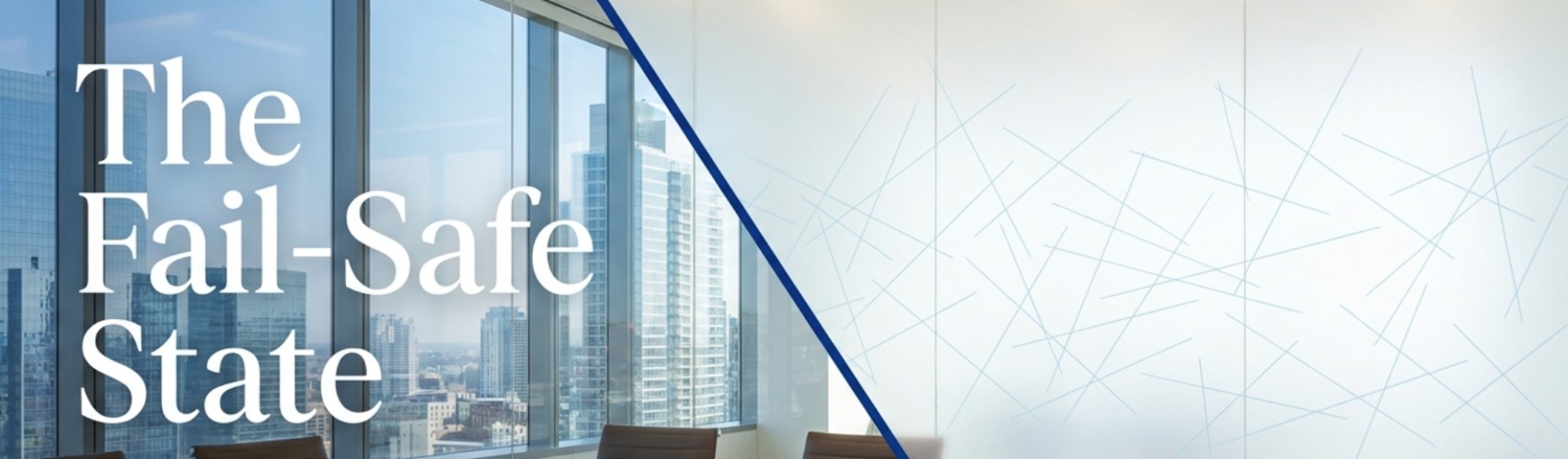
The complete guide to smart glass behaviour during power outages, blackouts, and electrical failures.
The Question Everyone Gets Wrong
If you asked ten people what happens to smart glass when the power goes out, nine of them would say the same thing: "It probably goes clear — and that means anyone outside can see straight in."
It is a logical assumption. Smart glass is powered glass. No power, no function. And if there is no function, surely it defaults to its most basic state — which must be transparent?
This is one of the most common misconceptions with respect to privacy glass in architectural glazing, and it is worth correcting clearly and completely — because the answer has significant implications for building security, privacy compliance, and specification decisions.
Smart glass does not go transparent during a power outage. It goes opaque. Instantly. Automatically. Every single time.
This article explains exactly why that happens, what the science behind it is, which types of smart glass this applies to, and why this fail-safe behaviour makes smart glass one of the most secure privacy glazing solutions available.
What Is Smart Glass? A Quick Primer
Smart glass — also called switchable glass, privacy glass, or electrochromic glass — is a category of glazing technology that can change its optical properties on demand. The most widely specified type for instant privacy switching is PDLC smart glass, which stands for Polymer Dispersed Liquid Crystal.
Other technologies in the smart glass category include:
- Electrochromic glass — changes tint gradually using an electrochemical reaction
- SPD glass (Suspended Particle Device) — controls light transmission using suspended particles
- Thermochromic glass — responds to heat rather than electricity
- Photochromic glass — responds to UV light
Each of these technologies behaves differently during a power outage. This article focuses primarily on PDLC smart glass and PDLC smart film, which represent the majority of privacy glazing installations worldwide — and which have the most clearly defined and security-relevant fail-safe behaviour.
How PDLC Smart Glass Works: The Science in Plain Language
To understand what happens during a power outage, you first need to understand what happens when the power is on.
When Power Is Applied
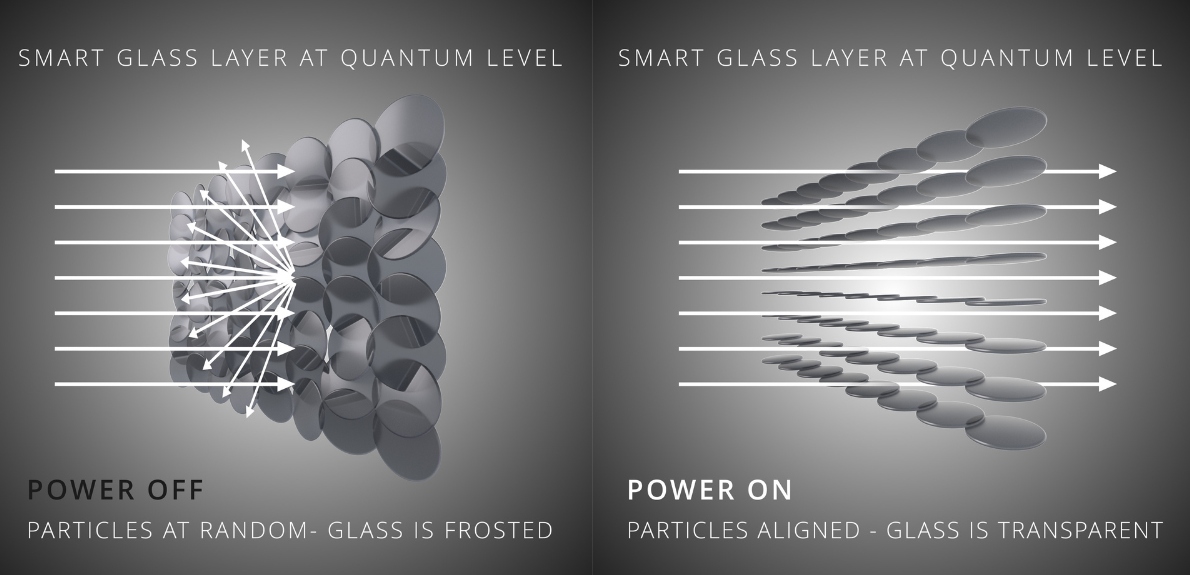
PDLC smart glass contains a thin film layer sandwiched between two panes of glass (or two layers of a laminate). This film contains millions of microscopic liquid crystal particles suspended in a polymer matrix.
When an alternating current (AC voltage, typically 110V or 220V at 50–60Hz) is applied to the film via transparent conductive coatings on the glass, the liquid crystal particles align in a uniform direction. When they are aligned, they allow light to pass through in a straight path — and the glass appears completely transparent.
This is the powered state: clear, open, and optically like standard glass.
When Power Is Removed
The moment the electrical current stops — whether because a switch is thrown, a breaker trips, or a full power outage occurs — the liquid crystal particles are no longer held in alignment by the electrical field.
Without that field, the particles revert to their natural, random orientation. In their scattered state, they refract and scatter incoming light in multiple directions rather than allowing it to pass straight through.
The result: the glass becomes frosted white and fully opaque.
This transition happens in less than 0.1 seconds — faster than the human eye can track.
The Key Insight
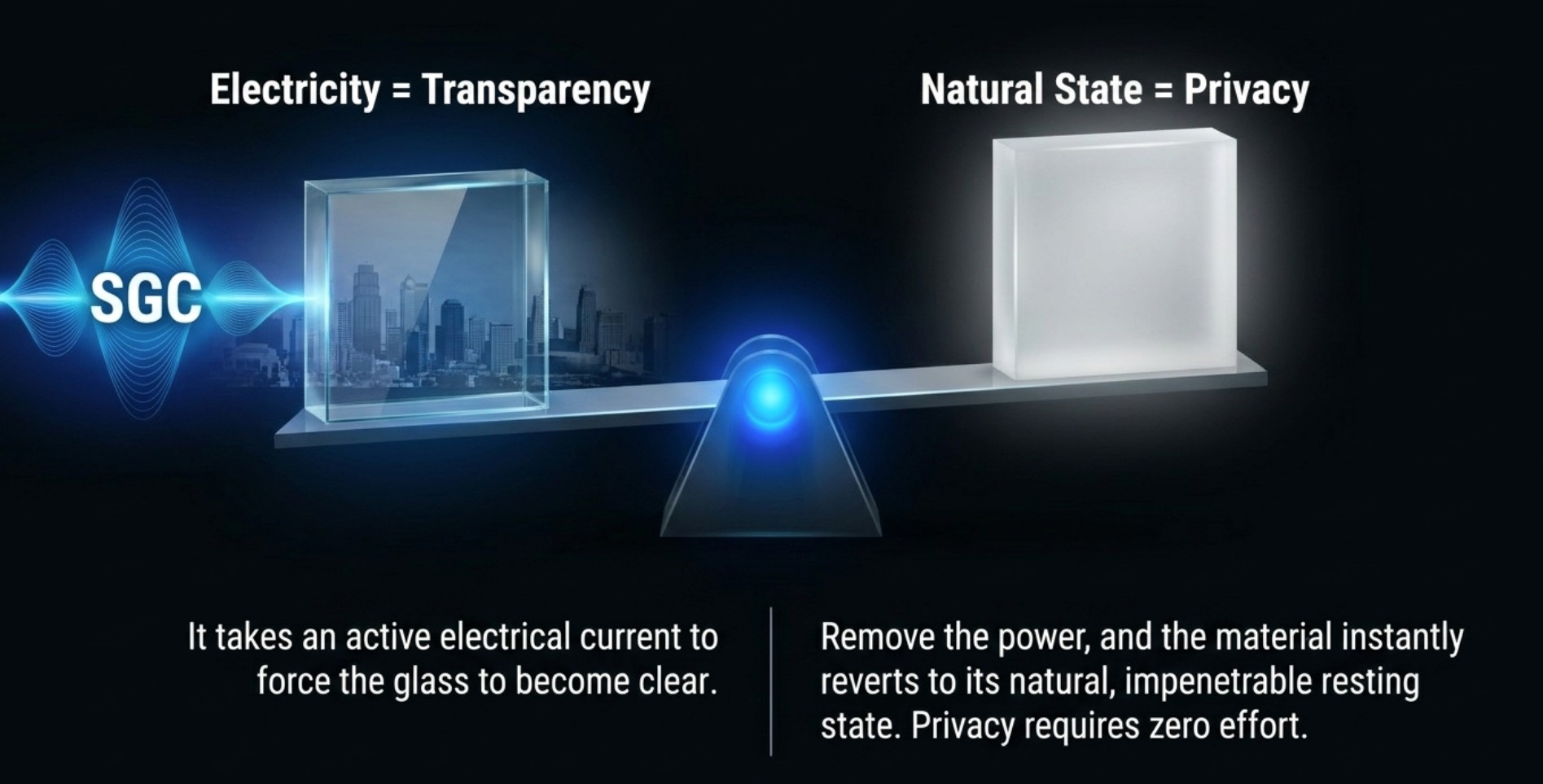
This is why the common assumption is backwards. People assume that electricity is what makes the glass private. In fact, electricity is what makes the glass transparent. Privacy is the natural resting state of the material.
Remove the electricity, and the glass does not fail open. It fails closed.
What Happens to Smart Glass During a Power Outage? Step by Step
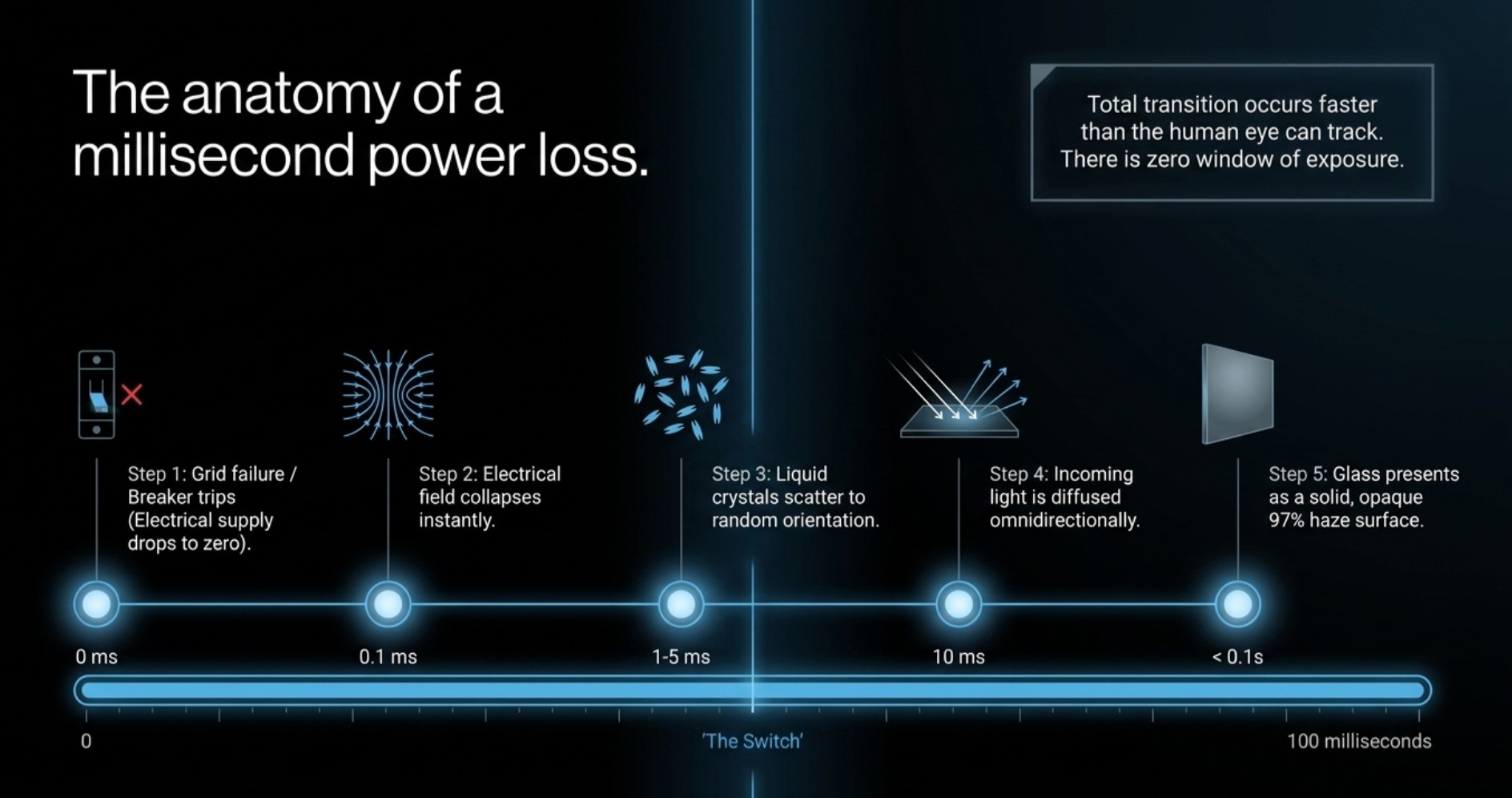
Here is exactly what occurs when power is lost to a PDLC smart glass installation:
Step 1: Power interruption occurs Whether from a tripped circuit breaker, a building-wide outage, a grid failure, or a deliberate switch-off, the electrical supply to the smart glass panel drops to zero.
Step 2: The electrical field collapses The AC voltage that was maintaining the liquid crystal alignment ceases immediately.
Step 3: Liquid crystals scatter With no field to hold them in place, the liquid crystal particles revert to their natural random orientation within milliseconds.
Step 4: Light scatters Incoming light hits the now-randomly oriented particles and is diffused in all directions rather than transmitted in a straight line.
Step 5: Glass appears frosted white From both sides of the panel, the glass presents as a solid, opaque frosted surface. No shapes, silhouettes, colours, or movement are visible through the glass.
Step 6: Light still transmits — but not visually An important nuance: the frosted glass still transmits a significant amount of ambient light. A room behind frosted smart glass during a power outage is not plunged into darkness — it is simply private. Light filters through softly, but no visual information passes with it.
Total transition time: under 0.1 seconds.
What Happens to Smart Film During a Power Outage?
Smart film — sometimes called switchable film or PDLC film — is a self-adhesive version of the same PDLC technology. It can be applied to existing glass panes, windows, glass partitions, and even plastic substrates, converting them into switchable privacy surfaces.
The power-outage behaviour of smart film is identical to that of smart glass:
- Power on = transparent
- Power off = frosted white and opaque
- Transition time = under 0.1 seconds
- Fail-safe state = private
The only meaningful differences between smart glass and smart film in this context are installation method and durability. The underlying PDLC physics is the same.
Does Smart Glass Stay Private Without Electricity?
Yes — unequivocally.
In its unpowered state, PDLC smart glass and smart film maintain full privacy without any active electrical supply. There is no degradation of the privacy effect over time, no slow fade back to transparency, and no partial transparency at any point during the power-off state.
This is not a battery-backed backup system. It is not a failover mechanism that kicks in when primary power fails. It is simply the natural physics of the material: privacy is the default, transparency requires work.
This characteristic is sometimes described in glazing specifications as "fail-safe" or "fail-secure" behaviour — terminology borrowed from security and access control systems, where failing safely means defaulting to the most secure state rather than the most open one.
How Fast Does Smart Glass Switch During a Power Outage?
The switching speed of PDLC smart glass is one of its most remarkable technical characteristics.
- Power on → transparent: approximately 1–5 milliseconds
- Power off → frosted: approximately 1–5 milliseconds
In practical terms, both transitions are imperceptible to the human eye. The glass appears to switch instantly.
This speed is relevant to power outage scenarios because it means there is no window of exposure between the moment power is lost and the moment the glass becomes opaque. Unlike motorised blinds (which take seconds to close), manually operated privacy screens (which depend on human action), or electrochromic glass (which transitions over 1–3 minutes), PDLC smart glass closes faster than a person can react.
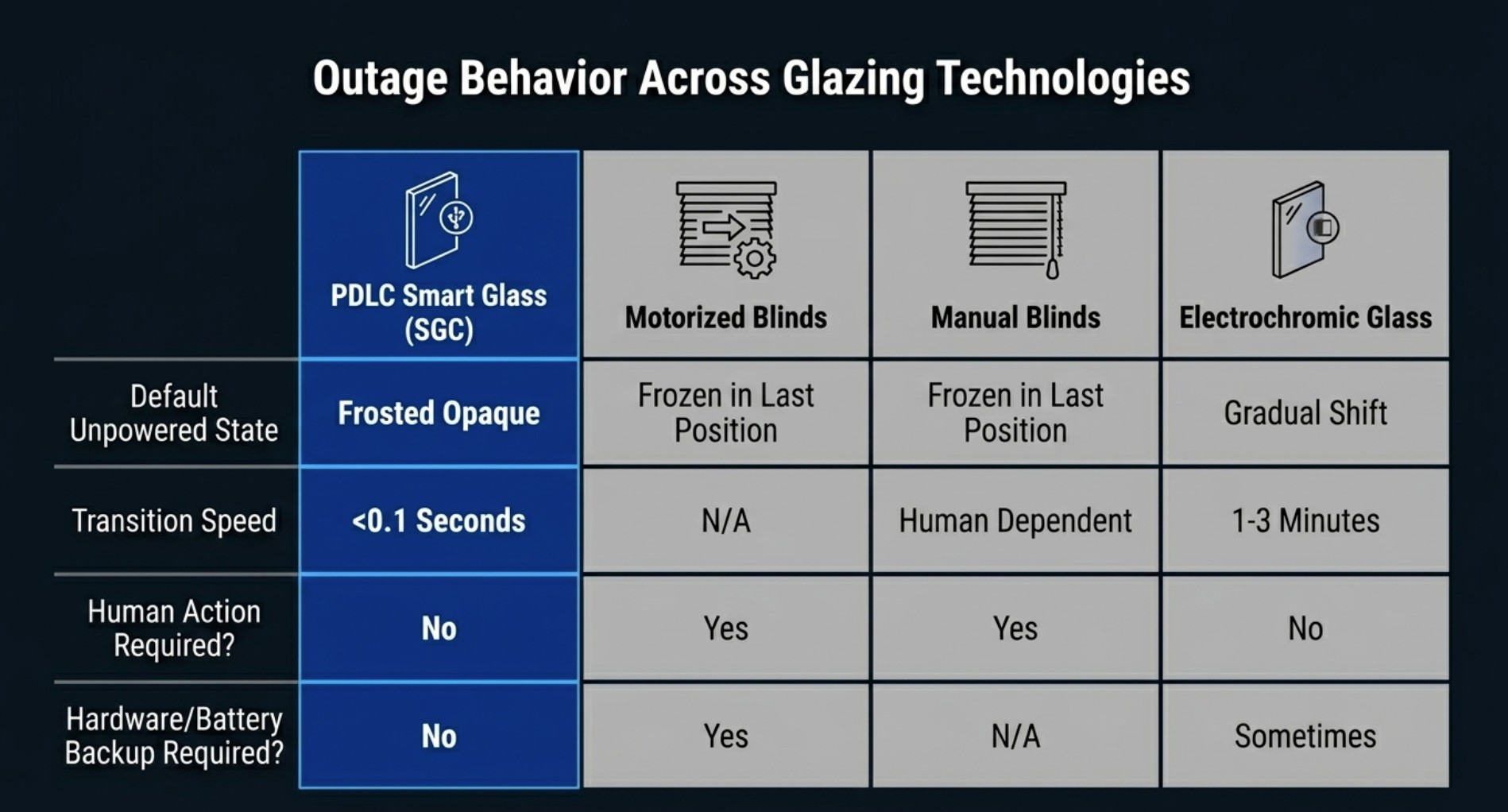
Smart Glass vs. Other Privacy Solutions During a Power Outage
Understanding how smart glass compares to alternative privacy solutions during a power failure helps clarify why its fail-safe behaviour is commercially significant.
Motorized Blinds and Shutters
Motorized window coverings require electrical power to operate. During a power outage, they remain in whatever position they were in at the time of the failure. If they were open, they stay open. There is no automatic fail-safe to a closed position unless a battery backup system is installed separately.
Manual Blinds and Curtains
Manual privacy coverings depend entirely on a person physically closing them. During an emergency, an evacuation, or a sudden unexpected outage, there is no guarantee that anyone will have time or presence of mind to close every blind in a building.
Electrochromic Glass
Electrochromic glass transitions gradually between tinted and clear states through a slow electrochemical process. During a power outage, behaviour varies by product and manufacturer — some hold their last state, some slowly transition. Crucially, none transition to full privacy in under a second.
Standard Frosted Glass
Standard frosted or sandblasted glass is always opaque — which is its own limitation, since it cannot be switched to transparent. It offers consistent privacy but zero flexibility.
PDLC Smart Glass
Offers the best of all configurations: fully transparent on demand, instantly and automatically private when power is absent. No manual input, no battery backup, no mechanical parts to fail.
Security Applications: Why This Matters
The fail-safe privacy behaviour of smart glass has direct implications for building security in the following scenarios:
Total Building Blackout
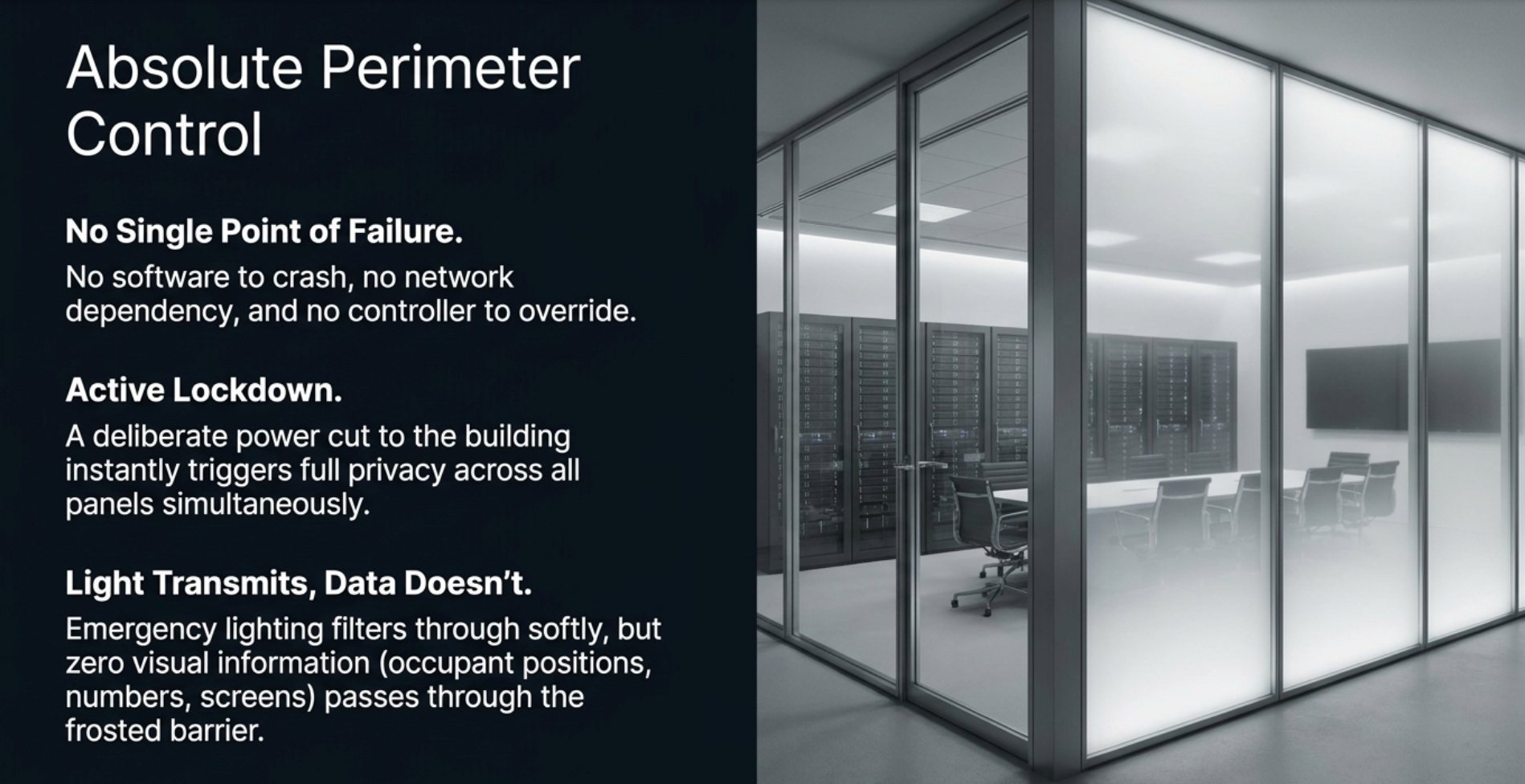
When a complete power failure hits a building, every smart glass surface instantly transitions to opaque. Ground-floor windows, internal partitions, VIP rooms, and server suites all become private simultaneously — without any action from security personnel.
Emergency Lockdown
In an active security incident, a building's power can be deliberately cut or may be disrupted as part of the event. Smart glass does not require a separate signal or secondary power supply to lock down. The power cut itself triggers full privacy across all panels.
Perimeter Security After Dark
External-facing smart glass during a nighttime outage presents a solid frosted surface to the outside. Emergency or backup lighting inside the building illuminates the interior softly but transmits zero visual information through the glass. Occupant positions, numbers, and activities are completely concealed.
No Single Point of Failure
Unlike access-control-based privacy systems that depend on a controller, a software system, or a network connection, PDLC smart glass requires none of these to maintain its fail-safe state. There is no server to crash, no controller to override, and no network dependency in the default private state.
Which Buildings and Applications Benefit Most?
The fail-safe privacy behaviour of PDLC smart glass is particularly relevant for:
Corporate and Financial: Boardrooms, executive suites, trading floors, legal offices, and any space where confidential conversations or commercially sensitive information must be protected even during infrastructure failures.
Healthcare: Patient rooms, consultation areas, operating theatres, and triage spaces where patient privacy is a legal requirement. A power outage does not suspend privacy obligations.
Government and Defence: Secure facilities, embassy buildings, government offices, and any installation where the disclosure of interior activities to outside observers represents a security risk.
Hospitality: Hotel suites, VIP areas, and spa facilities where guest privacy is a core element of the service proposition.
Education: Schools and universities have increasing requirements for lockdown-capable facilities. Smart glass partitions that automatically privatise during a power disruption contribute to passive security layering.
Residential: High-value residential properties with street-facing or ground-level glazing benefit from automatic privacy during power outages, particularly in dense urban environments.
Common Questions About Smart Glass and Power
Will smart glass break if the power goes out suddenly?
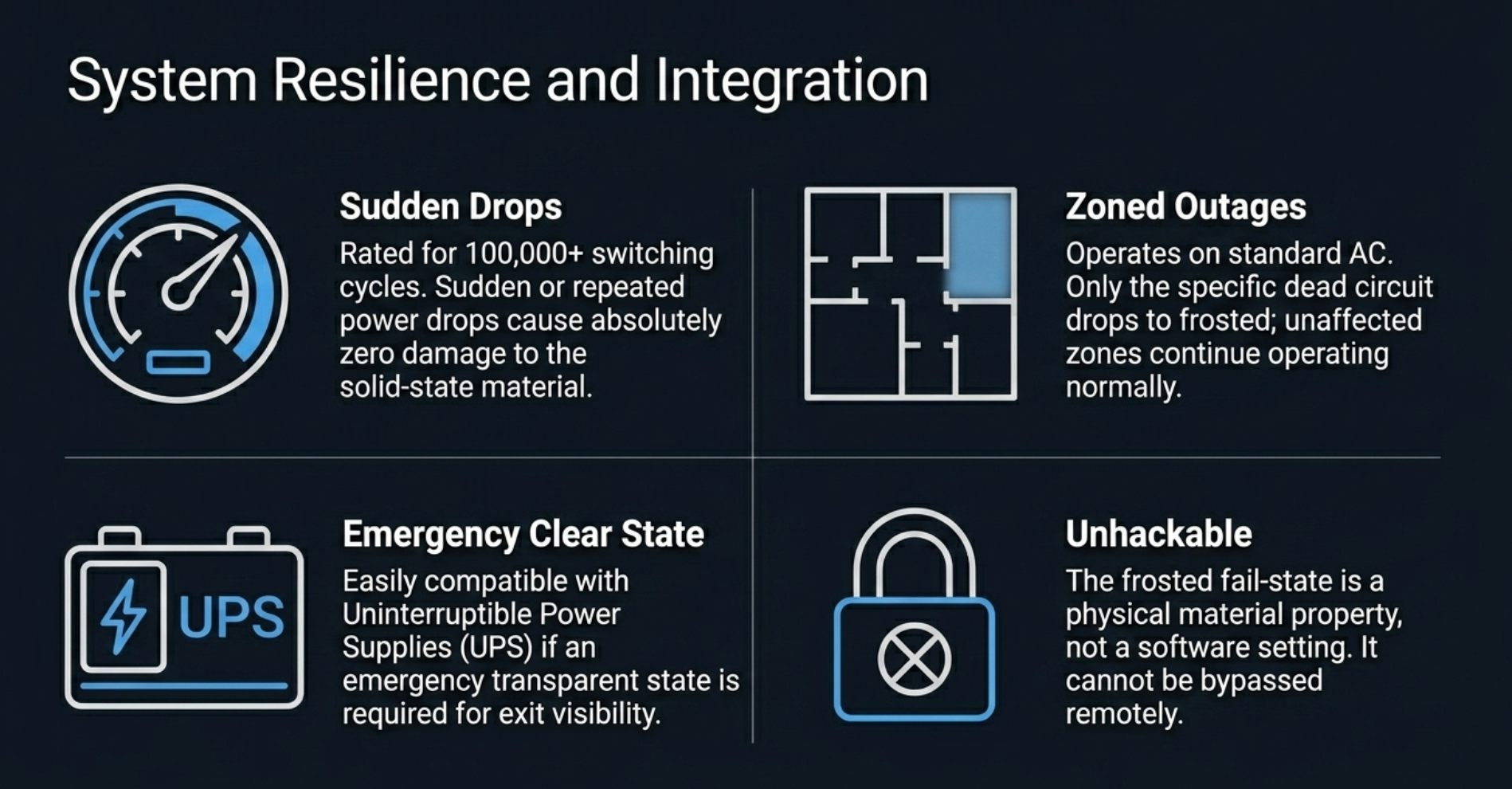
No. Repeated and sudden power interruptions do not damage PDLC smart glass or smart film. The switching mechanism is solid-state with no moving parts and is rated for hundreds of thousands of switching cycles.
Does smart glass need a special circuit?
PDLC smart glass operates on standard AC power. It does not require a dedicated circuit in most residential or commercial installations, though a qualified electrician should always be consulted during specification and installation.
Can I connect smart glass to a UPS (Uninterruptible Power Supply)?
Yes. If you require the glass to remain transparent during a power outage — for example, in an emergency exit corridor where visibility is required — a UPS unit can be connected to the smart glass controller to maintain the powered (transparent) state during short outages. This is an optional configuration, not a default requirement.
What if only part of the building loses power?
Smart glass panels are typically connected in zones. If one circuit loses power, only the panels on that circuit will transition to frosted. Other panels on unaffected circuits will continue to operate normally.
Does smart glass have a memory of its last state?
No. PDLC smart glass always returns to frosted when power is removed, regardless of what state it was in beforehand. There is no memory function in standard PDLC installations.
Can smart glass be hacked to stay transparent during a power outage?
The frosted state during a power outage is a physical property of the material, not a software setting. It cannot be overridden remotely, hacked, or bypassed without restoring physical power to the panel.
What Happens to Smart Glass Without Electricity?
Does smart glass go transparent without power?
No — it goes frosted and opaque
How fast does the transition happen?
Under 0.1 seconds
Does smart glass stay private indefinitely without power?
Yes
Does this apply to smart film as well?
Yes — identical behaviour
Is any manual input required to activate privacy during a power cut?
No — it is automatic
Can this be prevented without restoring power?
No — it is a physical property of the material
Is light still transmitted in the frosted state?
Yes — ambient light passes through, but no visual information
The Bottom Line
Smart glass — specifically PDLC smart glass and PDLC smart film — is the only widely available glazing technology that becomes more secure when it loses power, not less.
Its fail-safe default to a fully frosted, opaque state in under 0.1 seconds makes it uniquely suited to environments where privacy cannot be contingent on human action, software reliability, or uninterrupted electrical supply.
For architects, facilities managers, security consultants, and building owners specifying glazing for sensitive environments, this is not a minor technical footnote. It is a fundamental characteristic that distinguishes smart glass from every other dynamic glazing technology on the market.
To learn more about smart glass specifications, installation, and security applications, visit SmartGlassCountry.com or speak to our glazing specification team.
Related articles you may find useful:
- Can Smart Glass Turn Black?
- How is Smart Glass Powered?
- Smart Film vs Smart Glass: Which Should You Choose?
- What is the Difference Between Smart Glass & Regular Glass?
- What Materials Are Used in Smart Glass?


Subscribe to Our Newsletter
Never miss an update. Get all the latest news delivered directly to your inbox.
