
Smart Glass Products
Make ordinary glass extraordinary

Smart Glass
Smart Film
Smart Glass Doors
Dyed Black Film and Glass
Smart Glass Spaces
Buy Samples
Online Calculator
Smart Glass Applications
Discover how smart glass is being used to for privacy, security and smart design.

Smart Glass Information
We love sharing our industry knowledge, ideas and design tips!

Blog
FAQs
Warranty
Projects
Installation Guide
PRICE
Partner with Us


Smart Film vs. Permanent Frosted Window Film: Is the Upgrade Worth It?
Is Smart Film worth the upgrade from frosted window film? Compare switchable privacy with a static finish, including costs, installation, clarity, maintenance and warranties, to decide which option best suits your glazing, budget and everyday privacy needs at home.
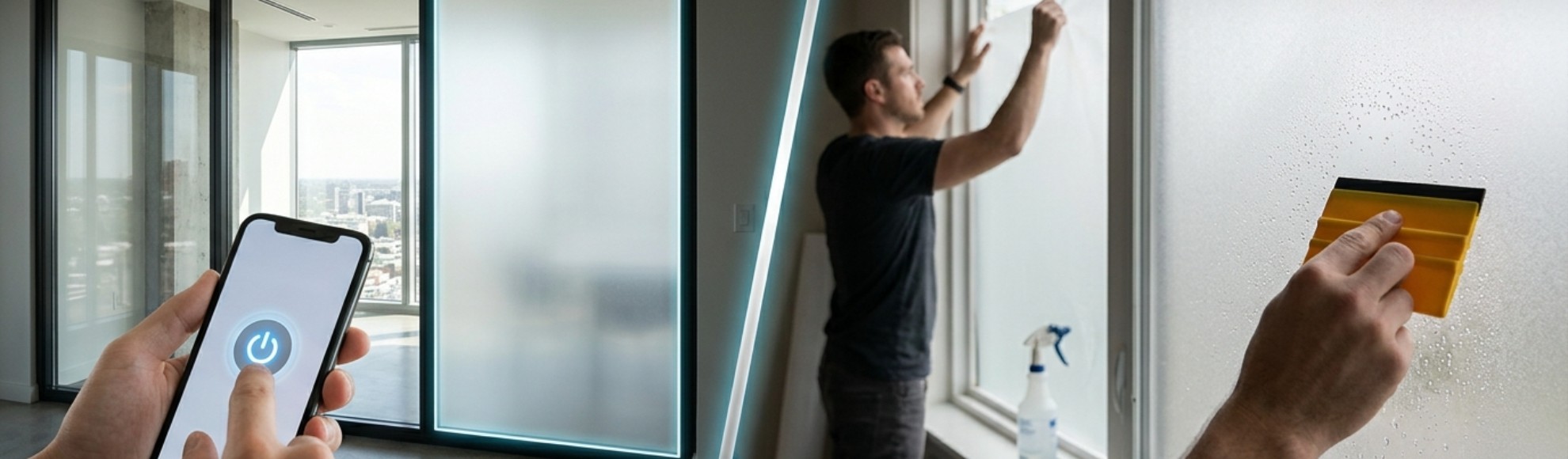
Frosted window film solves a privacy problem—and creates a trade-off. Once it covers your glass, the view stays obscured, even when you would rather see through it. Smart Film lets you change that decision with a switch.
Is that flexibility worth paying more for? Yes, when you regularly need both privacy and an open view. If the glass should stay frosted all day, conventional frosted film may already do everything you need.
Here is how to compare the two before committing to an upgrade, including the costs beyond the film itself.
What is the difference between Smart Film and frosted window film?
Conventional frosted window film gives glass a fixed, translucent finish. It obscures the view while allowing some light through, with the result depending on the film’s pattern and opacity. “Permanent” describes its appearance during use: many products can be removed, but they cannot switch to clear while installed.
Smart Film is an electrically switchable layer applied to suitable existing glass. It uses polymer dispersed liquid crystal technology, or PDLC. Standard Smart Film is frosted with the power off and transparent with the power on. A compatible switch, remote or control system changes its state without removing the film.
Both options can add privacy without replacing suitable existing glazing. The upgrade buys you control over when the view is obscured.
When is upgrading to Smart Film worth it?
When a room needs to change throughout the day
Imagine a glass meeting room beside an open office. A fixed frosted finish provides privacy for meetings, but it also hides the room when nobody needs that privacy. Switchable film lets the glass stay transparent between meetings, then turn frosted for a presentation, interview or sensitive discussion.
That is a strong reason to upgrade: the same room serves two different needs. Our guide to adding switchable privacy to a conference room explains the retrofit options.
The same question applies at home. Would you enjoy looking through a window during the day but want privacy at other times? Would a glass home office feel more connected to the house if you could clear the partition after work? If so, switching has a purpose you will use regularly.
When you want privacy without permanently giving up the view
A full-height frosted film can be effective, but it commits the covered area to one appearance. Smart Film makes more sense when retaining a view is part of why you chose glass in the first place.
Be specific about that value. A window facing a blank service wall gains little from becoming clear. A partition overlooking a carefully designed interior may gain much more. The best upgrade is the one that solves a problem in your actual space.
When controls make privacy easier to use
For a large partition or several panels, one control point can be useful. Decide whether you want every panel to switch together or separate areas to operate independently. Ask about compatible controls before ordering; app, voice and building-system integration depend on the controller and installation.
When permanent frosted film is the better choice
Choose conventional frosted film when you want continuous privacy, have no reason to restore the view, and want to avoid electrical work. It is also a sensible option for a decorative band or a limited-budget project where a fixed finish meets the brief.
A useful test is to ask: “If this glass could turn clear tomorrow, when would we use that feature?” If nobody can name a meaningful use, there may be little reason to pay for switching.
You can also prioritize the budget. Use switchable film on the panels where changing privacy matters most, and consider a fixed treatment elsewhere. Plan the visual result together so the finished space looks intentional.
How much more does Smart Film cost?
Conventional frosted film generally has the lower upfront cost because it does not require electrical components or wiring. Its installed price varies with the film, coverage, glass preparation and local labor. Compare a quote for the actual project rather than the price of a DIY roll against a professionally installed smart system.
Smart Glass Country’s published Smart Glass Cost and Smart Film Price guide lists Smart Film at approximately $37–$69 USD per square foot, depending on the product. Treat that as a budgeting reference and request a current project quote; older articles may show different ranges.
For illustration, 40 square feet at that published range would mean approximately $1,480–$2,760 USD for the film. This is a calculation, not an installed-price offer. Confirm exactly which electrical components are included and add installation, electrical labor, shipping, taxes and any required preparation.
Ask for an itemized quote covering the film grade and dimensions; transformer and controls; removal of existing film; installation and edge sealing; wiring and finishing; and delivery. Smart Glass Country’s pricing page confirms that installation is separate from product pricing.
The difference between the two complete quotes is your upgrade cost. Evaluate that difference against how often you will use the clear state, how important the view is, and how long you expect to use the space. Do not assume a guaranteed financial payback from energy savings or resale value.
What about electricity?
Frosted film needs no electricity. Standard PDLC film uses power while clear. As an example, using the 5 watts per 10 square feet stated in our cost FAQ, a 40-square-foot installation would draw about 20 watts. Running it clear for eight hours daily would use about 4.8 kWh over 30 days.
At an illustrative electricity rate of $0.15 per kWh, that is about $0.72 per month, before transformer losses or controller standby consumption. Actual use depends on the selected system and schedule. The main budgeting decision is usually the installed upgrade cost.
What will the glass look like?
Clear mode: expect some residual haze
Smart Film becomes transparent, but it should not be presented as identical to untreated glass. Some residual haze is normal for PDLC technology, and its visibility changes with lighting and viewing angle.
Our explanation of Smart Glass clarity and haze covers these differences. Compare a working sample in the intended location, looking straight through and from the side, in daylight and with the room lights on.
Smart Glass Country offers Classic, Crystal Clear and Ultra Clear grades. The Smart Film grades guide explains their differences. Choose based on the appearance you see, the application and the applicable warranty—not the product name alone.
Frosted mode: privacy with light, not blackout
Standard white Smart Film diffuses light when frosted. It does not turn a room dark. Conventional frosted films also vary in how much light they transmit, so compare the specifications of the actual products rather than assuming every frosted film performs alike.
For bedrooms or presentation rooms, treat darkness as a separate requirement. Likewise, a frosted appearance should not be taken as a promise that no silhouette can ever be seen. Check the proposed product with the expected lighting, viewing distance and distance between people and the glass.
Neither a frosted finish nor a switchable privacy layer by itself establishes acoustic confidentiality. A room used for private conversations also needs suitable walls, doors and acoustic detailing.
What changes during installation?
Conventional frosted film is a surface treatment. Smart Film is a surface treatment plus an electrical system, so there are more details to coordinate.
Start by confirming that the existing glass and its surface are suitable. Identify any coatings, tint or old film, and ask what must be removed. Applying Smart Film over frosted film would leave that underlying frosted layer in place, preventing a clear view.
Then plan the cable route, power supply, controls and access for servicing. Doors need particular attention because the wiring must accommodate movement. Resolve these details before the film is manufactured or installed.
Our Smart Film Installation Guide covers preparation, testing, application, wiring and edge sealing. Proper surface preparation and manufacturer-approved installation methods matter to both the appearance and reliability of the finished project.
For a bathroom, shower area or exterior-facing window, share the exact location and exposure with the supplier. Do not assume that every film or glazing combination is suitable. If the project already requires replacement glass, compare integrated Smart Glass as well; our article on whether Smart Film always costs less explains why the full installation can change the answer.
How do maintenance and warranty compare?
Both films need care appropriate to their surface. Obtain the cleaning instructions for the chosen product and avoid treating an exposed film as though it were bare glass. For Smart Film, follow guidance for protecting its edges and electrical connections.
A conventional frosted film has no transformer or controller to service. A smart system adds those components, so ask who handles product support, electrical troubleshooting and installation issues.
Compare written warranty terms alongside the price. Check what is covered, the installation requirements and whether labor is included. Review Smart Glass Country’s warranty terms before ordering; a warranty period is not a promise of a particular service life.
Questions to answer before requesting a quote
- Which panels need privacy, and when would you want them clear?
- What are the dimensions of each panel, and is the existing glass suitable?
- Are there old films, coatings, moving doors or moisture conditions to account for?
- Where can the wiring, transformer and controls go?
- Have you compared a working sample under your actual lighting?
- Does the quote include every component and service needed to finish the job?
Frequently asked questions
Can ordinary frosted window film be made switchable?
No. Conventional frosted film does not contain the electrically controlled PDLC layer. Upgrading normally means removing the existing treatment, preparing suitable glass and installing Smart Film.
Does Smart Film stay private during a power outage?
Standard PDLC Smart Film returns to its frosted state when power is removed. Confirm the operating behavior of the exact product and control system being specified.
Does Smart Film provide privacy at night?
Its frosted state does not rely on the outside being brighter than the inside, as reflective one-way films do. Nevertheless, assess the privacy level under nighttime lighting, particularly where someone may stand close to the glass.
Will Smart Film solve glare or overheating?
Do not select a privacy film solely on the assumption that it will solve either problem. Ask for performance information for the specific film and glazing combination. Privacy, glare reduction and solar heat control are related design considerations, but they are not interchangeable.
Is Smart Film worth it for one small window?
It can be, if you value switching that window between private and clear. Request a complete quote: on a small project, electrical work and installation can matter more than the film’s square-foot price.
Choose privacy you will actually use
Permanent frosted film is a practical choice when you want the view obscured all the time. Smart Film earns its place when the ability to bring that view back improves how you use the room.
Explore Smart Film samples, then send Smart Glass Country your panel dimensions, photos, location and preferred controls. We can help assess suitability and prepare a project quote so you can compare the upgrade on the terms that matter to your space.


Subscribe to Our Newsletter
Never miss an update. Get all the latest news delivered directly to your inbox.
