
Smart Glass Products
Make ordinary glass extraordinary

Smart Glass
Smart Film
Smart Glass Doors
Dyed Black Film and Glass
Smart Glass Spaces
Buy Samples
Online Calculator
Smart Glass Applications
Discover how smart glass is being used to for privacy, security and smart design.

Smart Glass Information
We love sharing our industry knowledge, ideas and design tips!

Blog
FAQs
Warranty
Projects
Installation Guide
PRICE
Partner with Us


Smart Film vs. One-Way Privacy Film: Which Is Right for Your Space?
Compare one-way privacy film with PDLC Smart Film for daytime and nighttime privacy, appearance, natural light, controls, automation and cost. Learn which option best fits your space. Smart Glass Country specializes in PDLC Smart Film solutions.
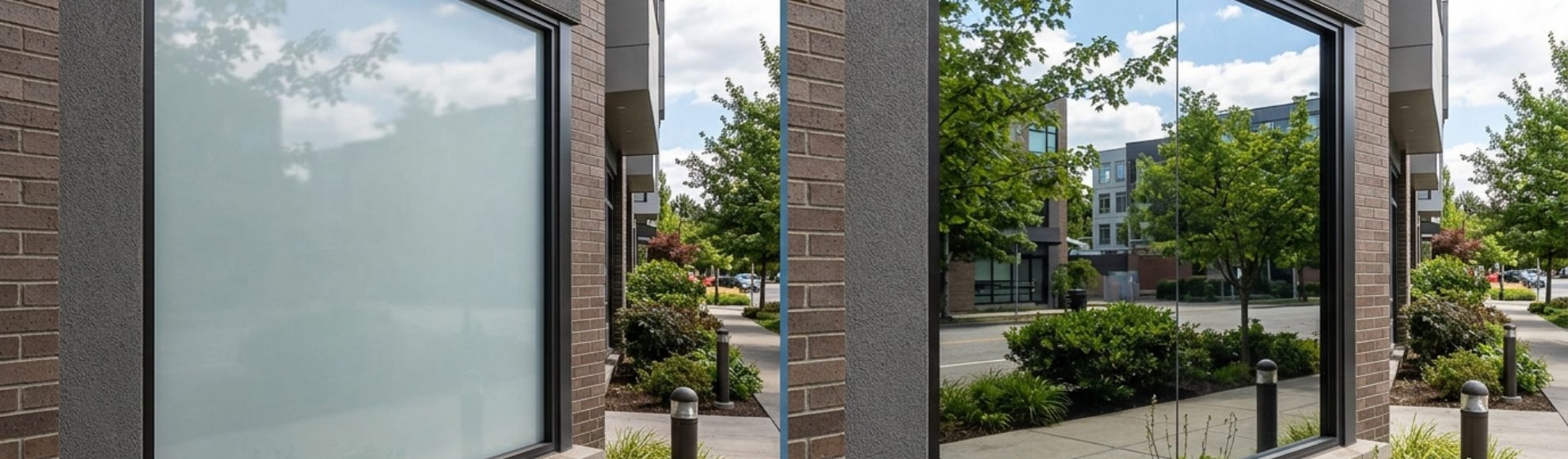
If you want more privacy from your windows or glass doors but still want to be able to see outside, you may be considering one-way privacy film or switchable Smart Film.
Both can improve privacy without permanently covering the glass, but they work in very different ways. One-way film, also known as one way mirror film, depends on the lighting conditions, while Smart Film lets you switch the glass between transparent and private whenever needed.
Here is how the two options compare—and what to consider before choosing one for your home or commercial space.
What Is One-Way Privacy Film?
One-way privacy film is a reflective window covering designed to make it more difficult for people outside to see into a building during the day. From inside, you can generally still see out.
The film contains a thin reflective layer, often made using metals such as silver or copper. Its performance depends on one side of the glass being brighter than the other.
- During the day, the exterior is usually brighter than the room. The film reflects outdoor light, creating a mirror-like appearance when viewed from outside.
- At night, the lighting conditions often reverse. Once the interior lights are turned on, people outside may be able to see into the room.
This means one-way film is not a complete day-and-night privacy solution. Curtains, blinds or another window covering may still be needed after dark.
Watch this video to learn about one way mirror film:
What Is PDLC Smart Film?
Smart Film is a switchable privacy film that uses Polymer Dispersed Liquid Crystal, or PDLC, technology. Its self-adhesive backing allows it to be applied to many types of existing glass and irregular window shapes.
Rather than relying on the difference between indoor and outdoor lighting, Smart Film uses a small electrical current to change its appearance.
- Power on: The liquid crystals align, allowing light to pass through and making the glass transparent.
- Power off: The crystals scatter the light, giving the glass a frosted appearance that obscures the view from both sides.
This transition takes approximately 0.1 seconds, allowing the same glass to provide an open view or privacy as needed.
Check out this video to see why smart film is a popular retrofit option:
Four Important Differences
1. Daytime and Nighttime Privacy
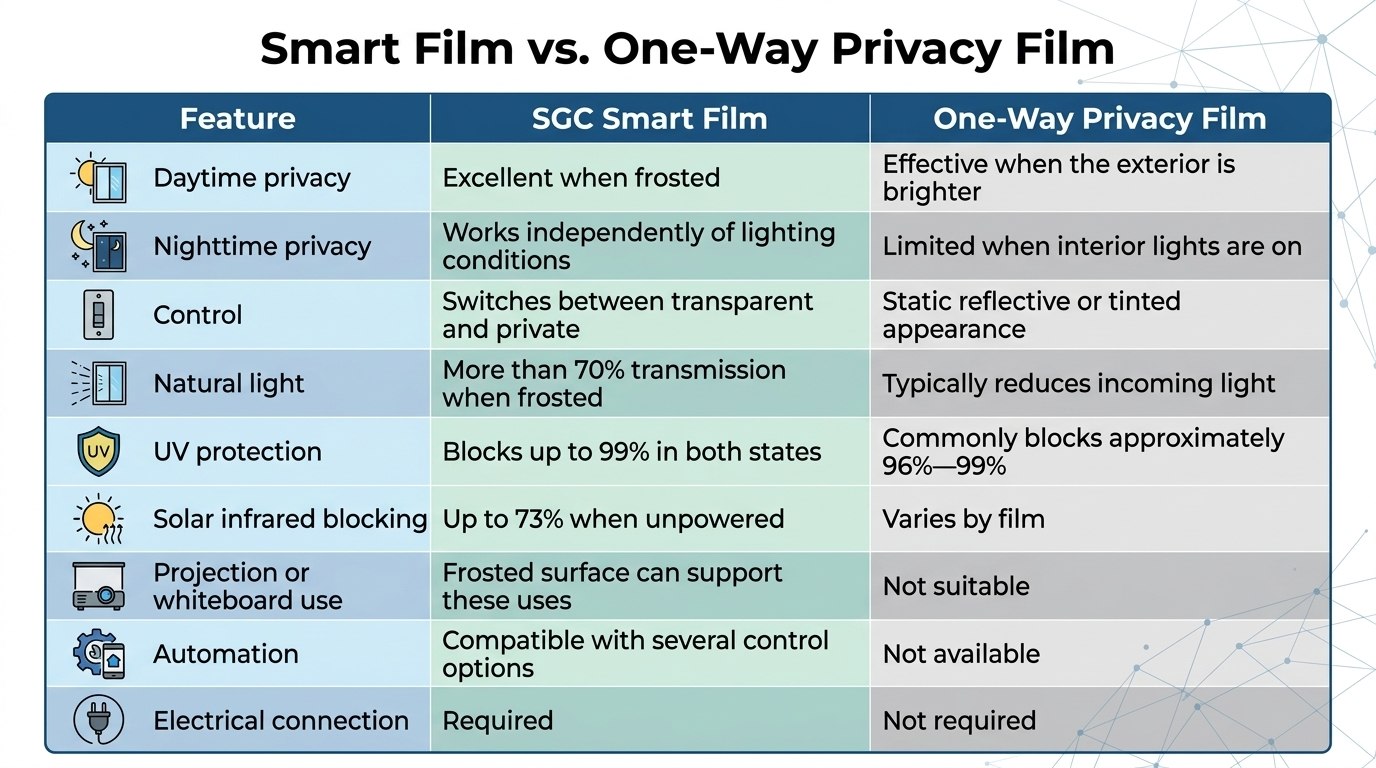
The main limitation of one-way privacy film is that it only works as intended when the exterior is brighter than the interior.
During the day, this is usually not a problem. At night, however, indoor lighting can make the room clearly visible from outside. You will generally need blinds or curtains if nighttime privacy is important.
Smart Film does not depend on the time of day. In its frosted state, it obscures the view through the glass whether it is noon or midnight. This makes it a more reliable option for bedrooms, bathrooms, offices, meeting rooms and other spaces that require privacy at different times.
Check out the video below to see what switchable privacy film looks like at night:
2. Appearance
One-way film creates a reflective or mirrored finish on the brighter side of the glass. Some people like this appearance, particularly on certain commercial buildings, but it may not suit every home, storefront or architectural design.
Smart Film has a more neutral appearance. When powered off, the glass looks frosted. When powered on, it becomes transparent. This can work well in spaces where the goal is to preserve a clean, contemporary look without adding curtains or blinds.
Smart Film can also be controlled with a dimmable transformer for applications where only partial privacy is desired- check out the video below to see dimmable smart film in action:
3. Natural Light and Heat
One-way privacy films usually reduce the amount of visible light entering a room. The exact effect varies depending on the film’s reflectivity and tint, but darker products can noticeably change the atmosphere of the space.
SGC Smart Film allows more than 70% of natural light to pass through even when it is in its private, frosted state. The light is diffused rather than blocked, helping the room remain bright while obscuring direct views.
Both products can provide UV protection. SGC Smart Film blocks up to 99% of UV rays in both states and can block up to 73% of solar infrared heat when unpowered. Actual performance and its effect on indoor temperatures will depend on the glass, installation location and overall window system.
4. Controls and Automation
One-way privacy film is static. Once installed, its appearance and performance cannot be switched or adjusted.
Smart Film requires a low-voltage electrical connection, but that also makes it much more flexible. Depending on the selected control system, it can be operated using:
- A wall switch
- A handheld remote
- A smartphone app
- Voice controls
- Timers
- A compatible home or building-automation system
SGC Smart Film consumes less than five watts per 10 square feet while powered on.
Watch the video below to see what smart film looks like installed on a glass front foor:
Smart Film vs. One-Way Privacy Film
Which Option Should You Choose?
One-way privacy film may be suitable if:
- You have a limited budget.
- You mainly need privacy during daylight hours.
- You are comfortable using curtains or blinds at night.
- You prefer a straightforward product that does not require electricity.
- A reflective exterior appearance suits the building.
Smart Film may be the better fit if:
- You need dependable privacy during both the day and night.
- You want to switch between an open view and a private surface.
- You prefer a frosted appearance instead of reflective glass.
- You want to avoid permanent curtains or blinds.
- You plan to connect the glass to a home or building-automation system.
The right choice depends on how and when you need privacy. One-way film is a practical, budget-friendly option for daytime use. Smart Film costs more and requires electrical planning, but it offers significantly more control and flexibility.
For a project estimate for smart film, contact us here or send the approximate dimensions and a few photos of your glass to info@smartglasscountry.com, or call 1-800-791-1977. Our team can review the application, confirm compatibility and recommend an appropriate Smart Film configuration.
Please note that Smart Glass Country does not sell one way privacy film (mirror film), only PDLC privacy film.


Subscribe to Our Newsletter
Never miss an update. Get all the latest news delivered directly to your inbox.
