
Smart Glass Products
Make ordinary glass extraordinary

Smart Glass
Smart Film
Smart Glass Doors
Electrochromic Glass
Smart Glass Spaces
Buy Samples
Online Calculator
Smart Glass Applications
Discover how smart glass is being used to for privacy, security and smart design.

Smart Glass Information
We love sharing our industry knowledge, ideas and design tips!

Blog
FAQs
Warranty
Projects
Installation Guide
PRICE
Partner with Us


Smart Film vs. Frosted Film: Why Switchable Privacy Glass Outperforms Static Tint
Smart film vs. frosted window tint: which actually wins? Frosted tint is permanent and one-note. Smart film (PDLC) switches clear-to-private in 0.1 seconds, keeps 70%+ of natural light when frosted, blocks 99% UV, and cuts heat gain — all controllable by app, voice, or

Smart Film vs. Frosted Film: Why Switchable Privacy Glass Outperforms Static Tint
Quick Answer
Smart film (PDLC film) switches between clear and frosted in 0.1 seconds using low-voltage electricity, letting you control privacy on demand while still transmitting over 70% of natural light when frosted. Frosted window tint is a static, permanently opaque sticker that offers no on/off control, no automation, and no secondary functions. For any space where privacy needs change throughout the day — conference rooms, bedrooms, street-facing offices — smart film is the better long-term investment; frosted tint only makes sense as a one-time, ultra-low-budget fix for a space that needs permanent opacity and nothing else.
Smart Film vs. Frosted Film

What Is Frosted Window Tint?
Frosted window tint is a static adhesive film applied directly to glass to permanently obscure visibility. It's inexpensive and easy to install, but once it's on, the glass stays opaque — there's no way to switch it back to clear. In offices, this permanence is a common complaint: applying frosted film to glass partitions closes off open-concept spaces and isolates teams from the rest of the room.
Frosted tint has one job: block the view. It doesn't manage heat, doesn't block meaningful UV, and can't be automated or reversed.
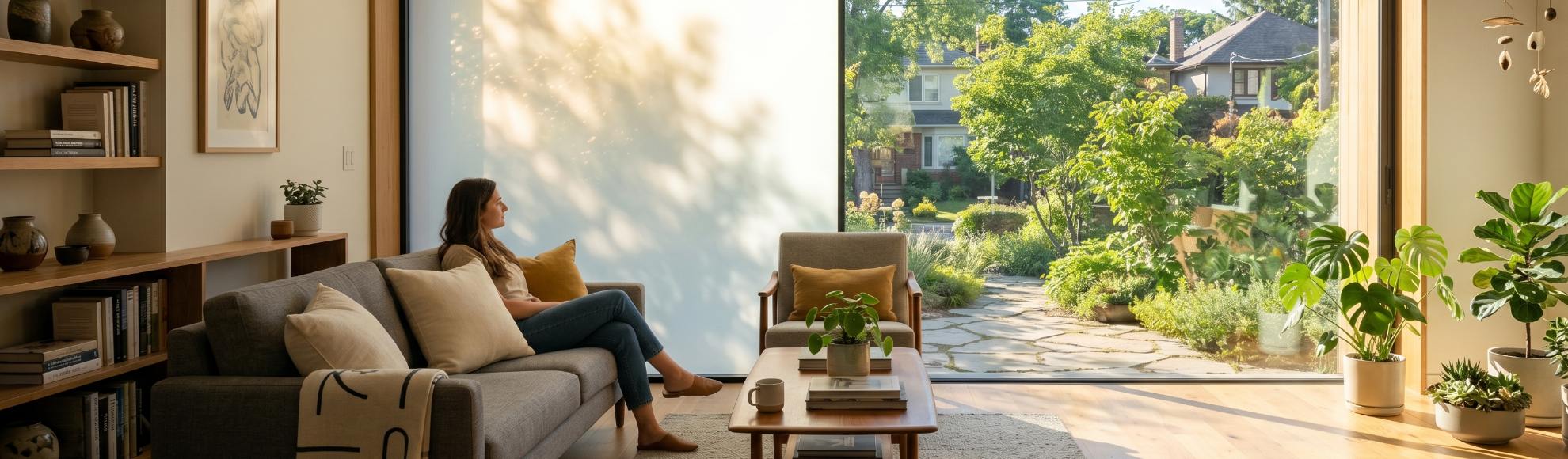
What Is Smart Film (PDLC)?
Smart film uses Polymer Dispersed Liquid Crystal (PDLC) technology to switch glass between clear and frosted in a fraction of a second. Like frosted tint, it's a self-adhesive film that retrofits onto existing glass — but that's where the similarity ends.
- Power ON: liquid crystals align, glass turns transparent
- Power OFF: crystals scatter light, glass turns instantly opaque
Because the state is controlled electrically rather than fixed by the material itself, the same pane of glass can serve as an open window one moment and a private, frosted surface the next.
5 Reasons Smart Film Outperforms Frosted Tint
1. Instant Privacy On-Demand
Smart film switches from clear to fully frosted in about 0.1 seconds — fast enough that conference rooms, bedrooms, and street-facing windows can stay open and bright by default, then go private the instant it's needed. Frosted tint offers no equivalent: the opacity is baked in permanently.
2. Higher Natural Light Transmittance When Private
Cheap frosted tint often darkens a room noticeably. Smart film is engineered to diffuse rather than block light, transmitting more than 70% of natural light even in its opaque, frosted state — full visual privacy without losing daylight.
3. Real UV and Heat Protection
Smart film blocks 99% of UV rays in both clear and frosted states, protecting furniture, art, and skin from sun damage. In its frosted state, it also blocks up to 73% of solar infrared heat, cutting cooling costs. Frosted tint provides little to none of this — it manages visibility, not climate.
4. A Multifunctional Surface, Not Just a Privacy Layer
Switched to its frosted state, smart film doubles as a rear-projection screen and a dry-erase whiteboard — a real asset for meeting rooms and collaborative workspaces. Frosted tint is a one-purpose sticker.
5. Built for Smart Home and Office Automation
Running on under 5 watts per 10 square feet, smart film can be controlled by wall switch, smartphone app, voice command, remote, or automation hub and timer. Frosted tint can't be automated at all — its state never changes.
Which One Should You Choose?
- Choose smart film if privacy needs change throughout the day, you want to preserve natural light and views, you care about UV/heat performance, or you want a surface that can double as a screen or whiteboard.
- Choose frosted tint only if the space needs to be permanently opaque, budget is the sole deciding factor, and none of the above matter.

FAQ
Is smart film the same as PDLC film?
Yes. "Smart film" is the common name for Polymer Dispersed Liquid Crystal (PDLC) film — the two terms are used interchangeably in the switchable glass industry.
Does smart film block more light than frosted tint?
No — it actually preserves more light. Smart film transmits over 70% of natural light even in its frosted, opaque state, while frosted tint permanently reduces light with no way to switch it back.
Can smart film be installed on existing glass?
Yes. Like frosted tint, smart film has a self-adhesive backing designed to retrofit onto existing smooth glass surfaces without replacing the pane.
How much electricity does smart film use?
Smart film consumes less than 5 watts per 10 square feet, making it inexpensive to run and easy to power through standard switches, low-voltage transformers, or smart home systems.
Can smart film be used as a projector screen or whiteboard?
Yes. In its frosted state, smart film functions as a high-definition rear-projection surface and a dry-erase whiteboard — a capability frosted tint doesn't have.
Ready to upgrade your static glass into a dynamic privacy solution?
Contact Smart Glass Country for a custom estimate, or order a sample kit to test switchable PDLC film firsthand.


Subscribe to Our Newsletter
Never miss an update. Get all the latest news delivered directly to your inbox.
