
Smart Glass Products
Make ordinary glass extraordinary

Smart Glass
Smart Film
Smart Glass Doors
Dyed Black Film and Glass
Smart Glass Spaces
Buy Samples
Online Calculator
Smart Glass Applications
Discover how smart glass is being used to for privacy, security and smart design.

Smart Glass Information
We love sharing our industry knowledge, ideas and design tips!

Blog
FAQs
Warranty
Projects
Installation Guide
PRICE
Partner with Us


The Future of Classrooms: How Smart Glass Is Reinventing Collaborative Learning
Smart glass is reshaping classrooms with flexible, light-filled spaces that support collaboration, focus, and modern teaching methods. By switching instantly from clear to frosted, it enhances engagement, preserves daylight, and future-proofs schools and campuses.
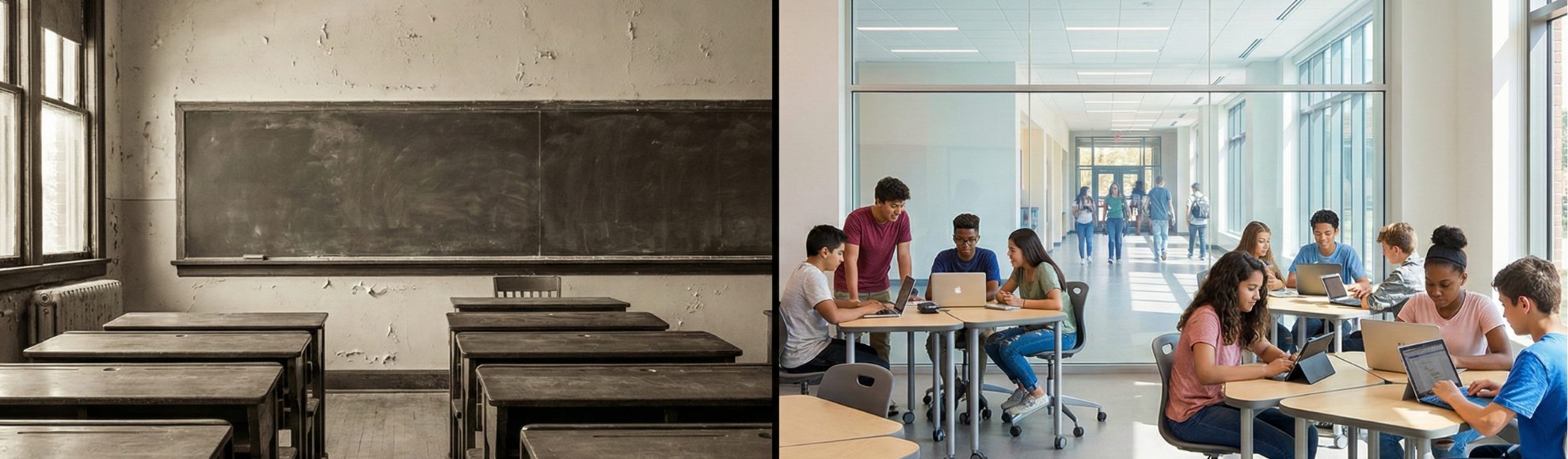
The classroom of the future isn’t just digital—it’s dynamic, flexible, and responsive. As teaching methods evolve and schools shift toward more collaborative, student-centered learning models, the physical learning environment is being reimagined alongside the curriculum.
One innovation is quietly transforming educational spaces around the world: smart glass.
From K-12 classrooms to university campuses and training centers, smart glass is enabling schools to move beyond fixed walls and static layouts—creating environments that adapt instantly to different learning modes while preserving daylight, visibility, and control.

Why Learning Spaces Need to Change
Traditional classrooms were designed for lecture-based instruction: rows of desks, fixed walls, and limited flexibility. But modern education increasingly emphasizes:
- Collaborative group work
- Project-based learning
- Small-group breakout sessions
- Hybrid and flipped classrooms
- Visual supervision paired with moments of privacy
According to the OECD’s Innovative Learning Environments framework, effective learning spaces must be adaptable, support social interaction, and respond to different pedagogical needs throughout the day—not just one teaching style. Static walls and opaque partitions often work against these goals.
Smart glass addresses this challenge directly.
What Is Smart Glass?
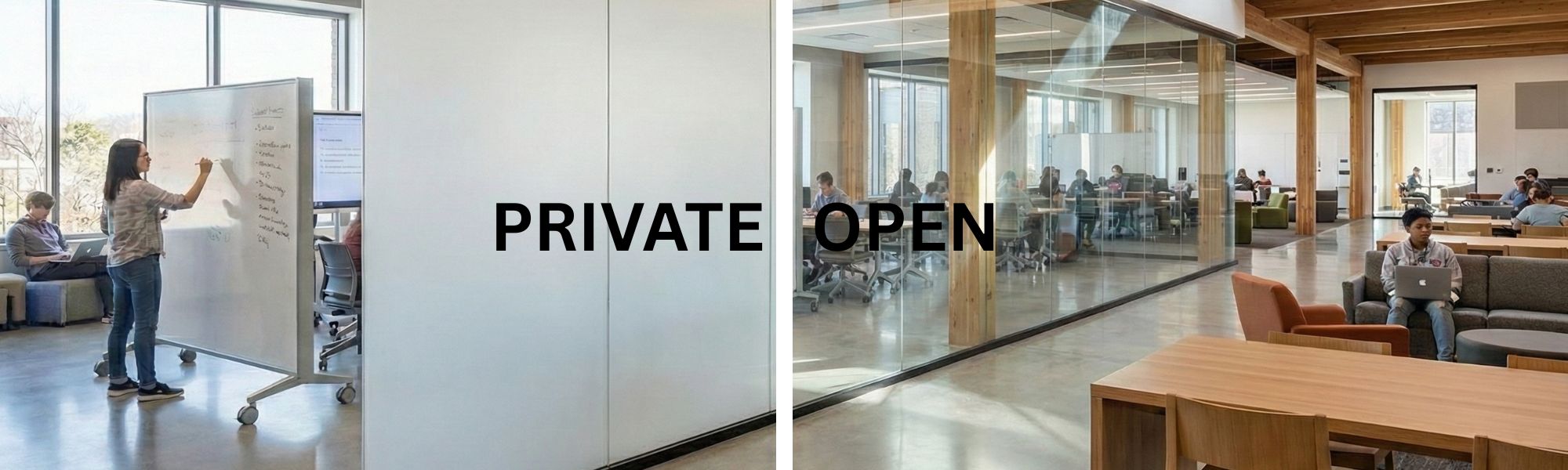
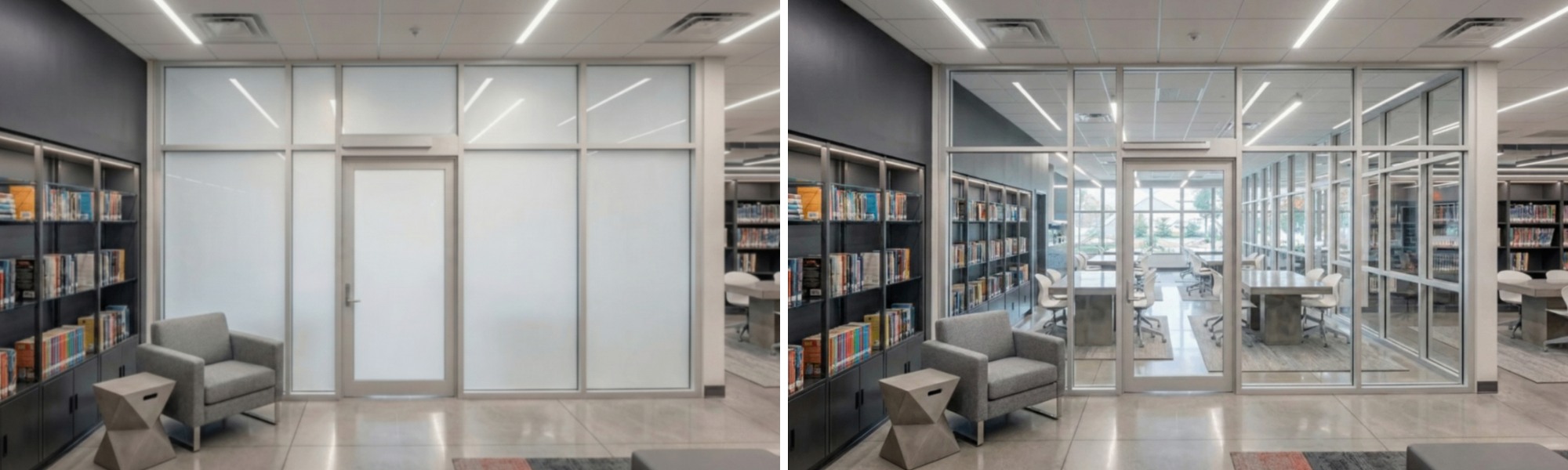
Smart glass—also known as switchable glass or privacy glass—uses PDLC (Polymer Dispersed Liquid Crystal) technology to transition from transparent to opaque in a fraction of a second with the touch of a button or an automated control.
When powered on, the glass is clear.
When powered off, it instantly becomes frosted, creating visual privacy while still allowing light to pass through.
Smart glass can be:
- Installed as part of new construction
- Retrofitted onto existing glass using smart film, making it ideal for renovations and budget-conscious upgrades
Unlike blinds or curtains, smart glass requires no mechanical parts, eliminates dust-collecting surfaces, and maintains a clean, modern aesthetic.
Supporting Modern Teaching Methods
Smart glass isn’t just an architectural feature—it’s an instructional tool that supports how students learn today.
Active and Adaptive Learning
Research consistently shows that students benefit from environments that can shift between focused and collaborative modes. A study published in Building and Environment found that visual distractions can significantly impact concentration and cognitive performance in learning environments.
With smart glass:
- Frosted glass minimizes distractions during tests, independent work, or lectures
- Clear glass supports openness, transparency, and collaboration during group activities
The room adapts instantly to the learning moment—without interrupting the flow of instruction.
Flexible Room Configurations
Modern classrooms are often expected to serve multiple functions in a single day. Smart glass partitions allow educators to:
- Divide large classrooms into smaller breakout areas
- Create temporary collaboration zones
- Reconfigure spaces without construction or permanent walls
According to Steelcase Education’s research on active learning classrooms, flexibility and spatial variety are strongly linked to increased student participation and improved learning outcomes.
Smart glass enables one space to function as many—without sacrificing daylight or supervision.
Increased Student Engagement
Engagement isn’t just about technology—it’s about environment.
The OECD and World Green Building Council both highlight that learning spaces which offer comfort, autonomy, and access to natural light improve student well-being and engagement. Smart glass supports this by:
- Preserving daylight even when privacy is needed
- Creating visually calm environments on demand
- Giving educators more control over how students experience the space
When students feel comfortable and focused, deeper learning follows.
The Power of Daylight and Transparency
Multiple studies confirm the importance of natural light in educational settings. One of the most cited studies by the Heschong Mahone Group found that students in classrooms with ample daylight progressed 20–26% faster in math and reading compared to those in poorly lit environments.
Unlike opaque walls or blinds, smart glass:
- Maintains daylight penetration
- Reduces reliance on artificial lighting
- Supports energy efficiency and sustainability goals
Transparency also supports safety and supervision—an essential consideration in schools and campuses.
Real-World Applications in Education
Smart glass is already being used across a wide range of educational settings:
- K-12 classrooms that shift between lectures and group work
- Libraries and media centers with private study pods
- University classrooms and labs requiring visibility, supervision, and privacy
- Training centers and vocational schools balancing safety and confidentiality
In laboratories and health-related programs, smart glass allows instructors to maintain visual oversight while protecting sensitive work or discussions—without installing permanent barriers.
Benefits for Schools and Campuses
✔ New Build or Retrofit Friendly
Smart glass can be installed in new construction or applied to existing glass using smart film—ideal for phased upgrades.
✔ Energy & Sustainability Benefits
By maximizing daylight and reducing artificial lighting, smart glass supports LEED and sustainability initiatives.
✔ Technology Integration Ready
Smart glass integrates seamlessly with automation systems, occupancy sensors, and AV technology.
✔ Future-Proof Design
Education will continue to evolve. Smart glass ensures your learning spaces can evolve with it—without costly renovations.
The Future Is Clear (and Frosted)
As education moves toward more collaborative, flexible, and student-centered models, the physical classroom must keep pace. Smart glass bridges the gap between openness and focus, transparency and privacy, structure and adaptability.
By embracing switchable glass, schools create environments that support how students actually learn today: together, dynamically, and in motion.
Want to Explore Smart Glass for Your School or Campus?
- Contact us for a personalized consultation
- Explore our interactive demo
- Get an estimate with our online smart glass calculator
References & Further Reading
- OECD. Innovative Learning Environments. Organisation for Economic Co-operation and Development.
- Steelcase Education. Active Learning Spaces Research & Insights.
- Heschong Mahone Group. Daylighting in Schools: An Investigation into the Relationship Between Daylighting and Human Performance.
- World Green Building Council. Health, Wellbeing and Productivity in Offices and Schools.


Subscribe to Our Newsletter
Never miss an update. Get all the latest news delivered directly to your inbox.
